
(Anyone can do it) How to create ‘business ideas’ for new ventures!

31 MIN READ
When starting a business, one always struggles with generating business ideas, specifically "what kind of business to do."
I want to start a business, but I don't know what to do.
I want to start a business, but I have no ideas.
These are among the top causes of the "problem of wanting to start a business but being unable to."
Most people seem to have struggled at least once with the problem of not knowing what to do.
However, generating business ideas is very easy.
No special abilities are required.
You can generate many ideas quickly.
However, it only requires a certain way of thinking and a flow of thought.
Once you get used to it, you'll be able to come up with any number of business ideas.
It is often said that business ideas alone are meaningless.
The saying "those who execute and achieve win" is common.
This is an overwhelming fact, and value is born precisely because it is realized.
Some people say they sell ideas, but ideas alone are worthless.
As I mentioned earlier, once you get used to it, ideas are generated infinitely.
Today, I want everyone to acquire the mindset of freely coming up with business ideas.
If you read this article, you will no longer need to be confused by "having no ideas."
Business ideas will always be born, and in fact, execution will struggle to keep up.
I am currently in exactly that state.
I want to do this. I want to do that too. But I don't have enough hands.
I hope you can take away such thoughts from today's article.
Before ideas, let's keep in mind a few ways to monetize and generate revenue.
First, no matter what you do, you must know how to monetize.
If you're running a business, it means getting money for something.
It's essential to clearly understand where we will get our money from.
A common pattern is having seemingly convenient ideas but no monetization plan.
A recent trend is the idea that if users gather, you can monetize anytime.
However, I don't particularly recommend this way of thinking.
This is because, in many cases, your resources run out while providing convenient ideas for free.
The monetization pattern after users gather is when you receive investment or have funds.
Most people, when starting individually, should think about monetization from the beginning.
Can you instantly think of what monetization methods exist?
Let's learn a few patterns of where to start monetization.
Monetization plans and ideas combine to create a business.
No matter how good an idea is, if you don't know how to monetize, the business won't run.
Here, we will introduce 6 basic monetization methods.
Please keep the basics of monetization methods in mind.
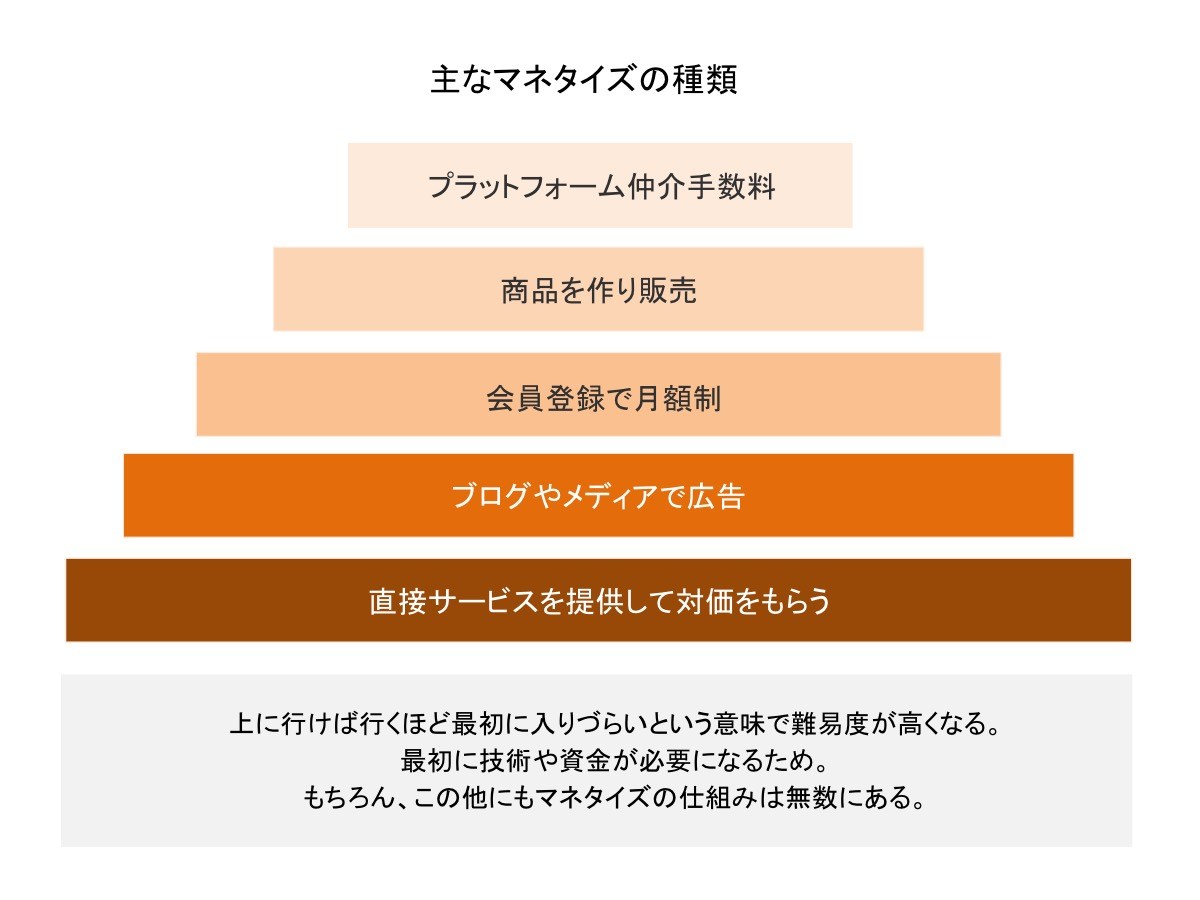
Monetization by directly providing services and receiving compensation.
This is a format where you provide your skills, knowledge, etc., and receive compensation.
There are various service industries such as website production and development, consulting, and house-sitting.
In the service industry, there are usually no direct costs.
The only cost is your own labor.
Agency businesses also fall into this category.
An agency provides sales capabilities for someone else's business.
They often charge a commission, which is similar to a fee for sales representation.
The advantage is that there are no direct costs, making it easy to start.
The disadvantage is that your income is tied to your working hours, so it doesn't scale easily.
Since it can be done by yourself, it's an excellent monetization method for the early stages of a business.
However, as mentioned earlier, it's difficult to scale significantly.
Unless you hire someone, you will always need to be actively working.
Basically, once you've earned money from a service business, it's good to create a subscription-based model while you have the capacity.
You provide a direct service and receive payment in return.
If a business succeeds in this form, your working hours will increase, and you'll have less free time.
As a result, you might not have time to try other monetization methods, so caution is needed.
Once you've earned a certain amount, diversify your income streams while maintaining the same pace.
Monetize with ads by publishing content on blogs and media
While monetizing with a service business, it's good to create a model that can be monetized with advertising.
Basically, you attract people by publishing interesting content such as articles, photos, and videos.
If the number of accesses and users increases, an advertising model will naturally form.
Specifically, we undertake advertisements from companies that are desired by the acquired user base.
Once a certain amount of access and users have accumulated, it's a good idea to propose to existing clients.
For example, displaying an ad for one month for 100,000 yen, or writing one ad article for 150,000 yen.
In return, if advertising effectiveness can be achieved, companies will pay a commensurate amount.
If it's too much trouble to get ads directly from companies, use Google AdSense or similar.
It's an advertising mechanism provided by Google, where compensation is paid according to the number of impressions and clicks.
You could also earn advertising revenue through affiliate marketing, etc.
Even if provided for free, if users gather, monetization through advertising is possible.
Advertising types can include banners, videos, articles, and all other forms.
By operating Facebook pages, Instagram, and X (formerly Twitter) in conjunction, the reach can be further expanded.
How many people you can acquire can be said to be the turning point of success.
Similarly, in many cases, website apps are also offered for free use and monetized through advertising.
If it's an easy-to-use tool, people will use it through word-of-mouth.
If users gather, you will naturally be able to generate value through advertising.
The advantage is that if you build solid content, you can monetize it even without actively promoting it.
The disadvantage is that it's difficult to create content that attracts people.
Basically, both creating content and attracting users to a website app require a huge amount of work.
Since it often takes time, we recommend steadily building it while monetizing through service industries.
Subscription-based monetization through member registration
Provide website apps and native apps for a monthly fee of 540 yen, etc.
Online salons with monthly fees ranging from several thousand to tens of thousands of yen also fall into this category.
It's a format similar to Horie Takafumi Innovation University.
Email newsletters are also monetized through a monthly subscription system.
The more users accumulate, the more fixed income increases.
It's stable and future developments are easy to predict, so it's a form you should definitely have.
Until a while ago, development skills were required to monetize with a monthly subscription system.
This was because it was necessary to create the mechanism for monthly billing oneself.
However, nowadays, there are several convenient services that provide monthly billing systems.
For example, a service called 'note'.
It's in a magazine format, allowing regular content distribution and monthly billing.
'MaguMagu' is a famous email newsletter platform that allows monthly billing.
Many people have probably already registered.
'DMM Salon' allows you to open a salon regardless of whether it's online or offline.
Horie Takafumi Innovation University is also in a salon format, so it's worth checking out.
'AnyPay' has no specific purpose defined and allows monthly billing.
It could be said that it only provides a monthly billing system.
Developers can freely develop with services like 'pay.jp' and 'stripe'.
Those with website and and app development skills should definitely give it a try.
Just by thinking about it briefly, this many services are available.
Increasing users is a steady effort, but in return, it leads to significant fixed revenue.
Also, operations and human labor are minimal.
A small number of people can control large sums of money.
It's good to have at least one monthly subscription service.
Monetize by selling products
It's a form where you create and sell your own products.
It involves production costs, and profits are low unless you produce a lot, so it's better to do it after you've gained some experience.
However, if you can sell in large quantities, it will generate enormous profits.
If you don't have much capital, you shouldn't delve too deeply into it.
If you don't have the stamina, even a business with high production costs won't be profitable.
Earning money by creating your own products is something for individuals or companies with a certain level of stamina.
Especially for those who are about to start a business, it's better not to consider it too much.
The usual outcome is just making things and ending up with inventory.
However, even so, there are ways to start small as a monetization method.
For example, cases where you make handmade goods.
Currently, flea market apps and peer-to-peer transaction services are also well-developed.
Mercari and Yahoo Auctions are good examples.
Using Stores.jp or BASE, you can easily build a shopping site.
Sometimes, small-scale started goods and items become popular.
If they become popular and production can't keep up, you'll be able to expand.
The number of people willing to invest will also likely increase.
If you're going to create items, try starting small with flea market apps, etc.
In this day and age, there's no need to pay a large sum of money to launch a shopping site.
Instead of opening a physical store from the start or taking on big risks unnecessarily, begin with what you have.
Start selling from the smallest unit and gradually expand your sales channels.
Create a platform and monetize through intermediary fees.
Create a website app or native app, and have users conduct some kind of transaction with each other.
From the amount generated at that time, you receive a commission.
I introduced Mercari and Yahoo! Auctions, and these services fall into that category.
Mercari monetizes through intermediary fees generated when individuals buy and sell products with each other.
Yahoo! Auctions, Stores.jp, and BASE are similar.
Street Academy, which matches people who want to learn with those who want to teach, also operates on a commission basis.
Services that are expanding relatively largely are often based on a commission model.
Since users don't need to pay upfront, it's easy to expand.
However, the commission model requires development capabilities and technical skills.
Moreover, if you delve into it half-heartedly, operations become difficult.
Dealing with problems when they arise is also extremely complex.
It's better to get some business experience before tackling this.
The advantage of platform fees is that there are no initial costs, making it easy to spread.
The disadvantage is that a certain level of development capability and experience is required to implement it.
If you can overcome the disadvantages, it becomes the most easily spread monetization method.
This is a format I definitely want you to try in the future.
The basis of business idea creation lies in problem-solving.
Did you get a general idea of how to monetize?
There are countless other monetization methods, so it's a good idea to explore them yourself.
Now, let's finally get into idea creation.
Coming up with business ideas is easier than you might imagine.
Anyone can come up with innovative business ideas.
That's why it's said that ideas alone have no value, and the person who realizes them benefits the most.
Basically, a business starts with solving someone's problem.
This also relates to the mindset we discussed last time.
Solving problems that someone is facing, solving societal problems.
It can be said that creating business ideas starts with looking for problems in the world.
It might be more accurate to say "noticing" rather than "searching."
Solving social problems or someone's problems might seem like a big deal.
But in reality, even the smallest problem can become a business if you notice it.
Don't think too big; it's good to start casually.
Business ideas centered around problem-solving have three main advantages.
Let's explain each one in order.
The needs are already clear and easy to spread.
There are many problems in the world, but there's something common to all of them.
Everyone is 'in trouble'.
Being in trouble means there are many people who want to solve it, even if they have to pay.
Without even needing to convey the value of the business idea, it is already recognized.
They want something that will solve this problem.
People always think that way, so you just need to solve it for them.
However, business is business, so there will be a price for it.
Instead of solving the problem, consider how much to charge.
The balance between price and the value of the solution makes a business viable.
How to monetize it, as I've already explained.
Let's consider how much to receive and in what form to solve the problem.
The existence of a problem means that everyone already knows its value.
That's why, even without desperate marketing, it will be sought after and spread.
Let's recognize that all problems in the world are seeds for business ideas.
There are almost no competitors.
The fact that a problem still remains a problem means there are few competitors.
If existing ideas haven't fully solved the problem, it's as good as not being widespread.
Even if someone else is working on it, there are plenty of opportunities to get involved.
Even if similar ideas already exist, you should ignore them.
Rather, a stance of 'let's solve the problem together' is just right.
However, once you succeed, competitors will enter the market endlessly.
Naturally, they will enter by refining existing ideas.
While gaining first-mover advantage, it is necessary to constantly improve the service.
If you don't improve it, you will be quickly replaced by successors.
Conversely, even if you are a successor, if the quality of your product or service is high, you can win.
Don't worry too much about competitors; let's do what we need to do.
It has extremely socially beneficial and innovative elements, making it easy to become a topic of conversation.
Tackling problems that have not yet been solved means it is 'new'.
Because it is new as an idea and as an initiative, it can solve existing problems.
In other words, it means nothing less than gaining topicality.
The more socially beneficial a business idea is, the more support it will receive from others.
Receiving support means there will be many people who introduce it.
It will never be a lonely battle.
Many people will lend a hand to realize the idea.
Since you are helping people in trouble, it's a natural progression.
Of course, you can also receive support from media and companies.
Interviews and introductions will also steadily increase.
Precisely because it's not just a new attempt, everyone will support and spread it.
The power to involve people and co-create is essential for problem-solving.
But how do you discover problems?
I understand that problem discovery is important for business ideas.
However, some may wonder, "How can problems be discovered?"
Even if you understand its importance, it's meaningless if you can't find the problems.
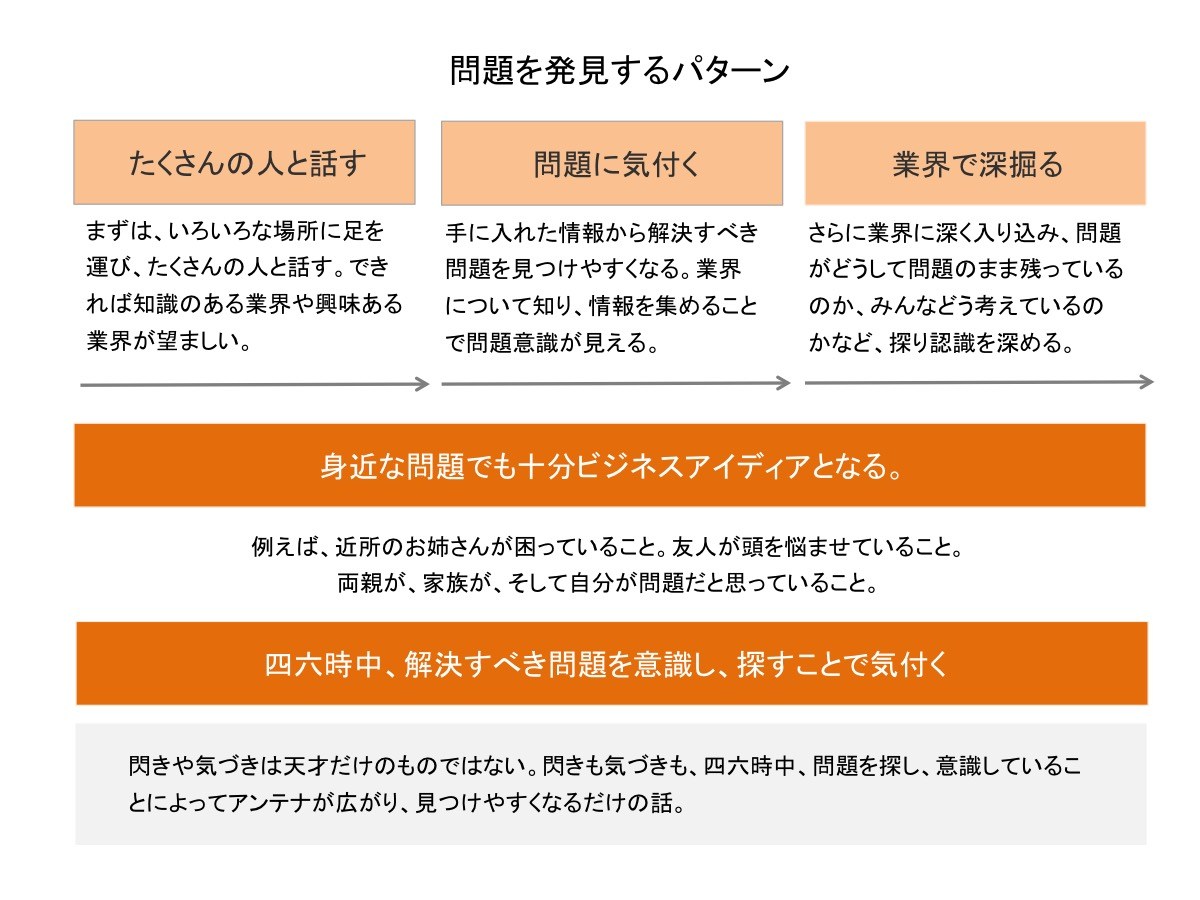
A concrete method is to simply go to various places and talk to people.
It would be even better if it's an industry you have knowledge of.
An industry you're interested in or want to tackle is also fine.
Parties, events, conferences, exhibitions, networking gatherings.
There are many places, so it's good to visit them and talk to many people.
Then, gradually, industry-specific problems will become apparent.
What are they struggling with, and why can't it be solved?
As you accumulate knowledge, the full picture will gradually emerge.
However, a question might arise here.
That is, "Can a newcomer really solve problems?"
If more professional people can't solve it, can I?
You might sometimes think that way.
However, it's often precisely because they are professionals that they cannot solve problems.
Being in an industry for a long time can lead to accumulating fixed ideas.
Thoughts become rigid with the perception of 'this is how it should be'.
Innovative solutions often arise from combining different industries or knowledge.
As will be introduced in the next section, flexibility to accept all possibilities is necessary.
You must not be trapped by the concept of 'this is how it should be'.
Because we are bound by a certain way of thinking, problems remain as problems.
If we can openly accept ideas from other industries, there's a possibility of solving them.
Being a professional does not necessarily lead to problem-solving.
Rather, precisely because it's a new approach, one can delve into it without being bound by conventional wisdom.
Even familiar problems can be good business ideas.
For example, what the older sister next door is troubled by.
What a friend is racking their brain over.
What parents, family, and oneself consider to be problems.
All of these can become business ideas.
Problems found in daily life can be sufficiently discovered just by 'the awareness to notice problems'.
If you are constantly aware of whether there are any problems, you will find them quickly.
There are countless problems that must have been happening right in front of us, yet we couldn't recognize them.
That's because we weren't aware of them and didn't pay attention.
It is precisely because we continue to be aware that we can recognize problems as ideas.
In fact, this 'awareness' is the true nature of 'realization'.
When watching documentaries about entrepreneurs, moments of 'realization' are sometimes depicted.
Rather, isn't such a moment present in all documentaries?
It wasn't because they were a genius or anything, but because they were aware, they didn't miss it.
Anyone, if they are thinking about solving a problem, won't miss even small things.
They tend to connect everything to solutions.
That's why you can realize, "This is it!"
In particular, ideas that you yourself are struggling with are easy to use.
Because you are both the one solving the problem and the user.
When creating a business, you create it while interviewing users.
If you are the user and the customer, you understand all their thoughts.
The problems you feel are the ideas that are more likely to be realized.
Have you understood how to find problems and find ideas?
Problem-solving leads to more readily accepted business ideas.
By all means, try to keep your eyes peeled and be aware in your daily life.
Once you start being aware, you often find problems within a month.
Calculate the number of people who have the problem.
Now, once a problem has been found, let's calculate the market size.
Market size sounds difficult, but it's essentially how many potential customers there are.
It becomes clear by extracting data from the internet, books, and so on.
If you don't calculate the market size, it's possible that "there were actually no customers at all."
It's not uncommon for you to be the only one who was troubled.
As an example, let's calculate the scale from "services for people who want to learn entrepreneurship."
Rough estimates are fine at first.
First, find out how many people want to start a business.
Searching on the internet, I found government documents.
According to the data, about 17% of people in Japan want to start a business.
17% translates to approximately 20 million people.
Let's aim to acquire about 5% with this service.
5% is roughly 1 million people.
If we deliver a service costing 540 yen per month to 5% of those who want to start a business, we would generate 540 million yen in monthly revenue.
How would you view this figure of 540 million yen in monthly revenue?
In reality, we would investigate in more detail, but for the idea stage, this is sufficient.
It's good to set this as a goal.
The next step is how to solve the problems and make it a reality.
It's around this time that the outline of the business idea starts to become visible.
Combine two business models to come up with a solution to the problem = a business idea.
Problem discovery is merely the "seed" of a business idea.
What actually becomes a business is the "solution" to the problem.
The solution becomes a service or product, and then a business.
Just finding a problem is meaningless as a business.
Value is only created when it is solved.
So, how should we come up with solutions?
Earlier, I mentioned not being bound by preconceived notions.
Usually, solutions to problems can only be achieved with new concepts.
For the problems that remain, any conceivable ideas have already been exhausted.
It remains in today's society because it couldn't be solved even after everything was tried.
So, how can we generate new ideas?
Therefore, we use a method of combining two business types.
For example, let's consider solving the problem of children on waiting lists for daycare.
Perhaps some people are currently troubled by this.
First, list multiple business types that seem related to the problem.
In this case, it's good to choose business types related to the problem of children on waiting lists.
We call this an "related domain".
After a quick thought, I was able to list the following.
Related domains :
Cram schools, study abroad, children's clothing, training camps, kindergartens, daycare centers.
I picked them intuitively, but there are countless others.
The more there are, the easier it is to leap to various ideas.
Once you've listed the related domains, next, choose domains that seem completely unrelated.
Choosing unrelated domains is to discard all preconceived notions.
To solve with new ideas, you need to broaden your perspective even more.
It's good to list business types, focusing on new ones that have recently emerged.
New ways of thinking and ideas centered around IT tend to influence existing businesses.
Completely unrelated business domains, we call these "unrelated domains".
Unrelated domains :
VR, AI, IoT, sharing economy, fintech.
Food and beverage, fashion, agriculture, nursing care, healthcare, supermarkets.
The above are also just things I thought of randomly.
Of course, there are still many more.
Once you've listed items in two domains, the next step is to combine them.
Let's try to combine things that seem interesting and come up with ideas.
Kindergarten × Sharing Economy
Could a kindergarten be operated using a system like Uber or Airbnb?
For example, a system where children can be entrusted to people who have free time and rooms.
Camps × Agriculture
Could children be entrusted for a certain period to experience agriculture?
What if both parents could work together and receive wages?
Daycare × Healthcare
Existing daycares are expensive, and the system itself is inferior to kindergartens.
In that case, could value be added, such as by perfecting health management?
Alternatively, could healthcare products and services be offered to parents to lower the price?
There should be a domain for a higher-level daycare.
Cram School × Nursing Care
Rather than nursing care, it's about the elderly, but how about the elderly running old-fashioned cram schools?
By having the elderly teach traditional ways of playing, could we create jobs for the elderly and match places for children to be looked after?
It could lead to the creation of jobs for seniors, and children could be looked after, solving two problems simultaneously.
As a possibility, combining nursing homes with daycare centers might be an option.
Daycare × Supermarket
If daily necessities could be purchased at the daycare center, couldn't the prices be lowered accordingly?
By buying everyday items from the daycare center instead of the supermarket, sales would be supplemented.
Couldn't the cost of the daycare center be reduced by that amount?
While writing this, I've come up with 5 patterns of ideas.
Although I'm used to it, it only took about 10 minutes.
What do you think?
Some quite interesting ideas have emerged, haven't they? 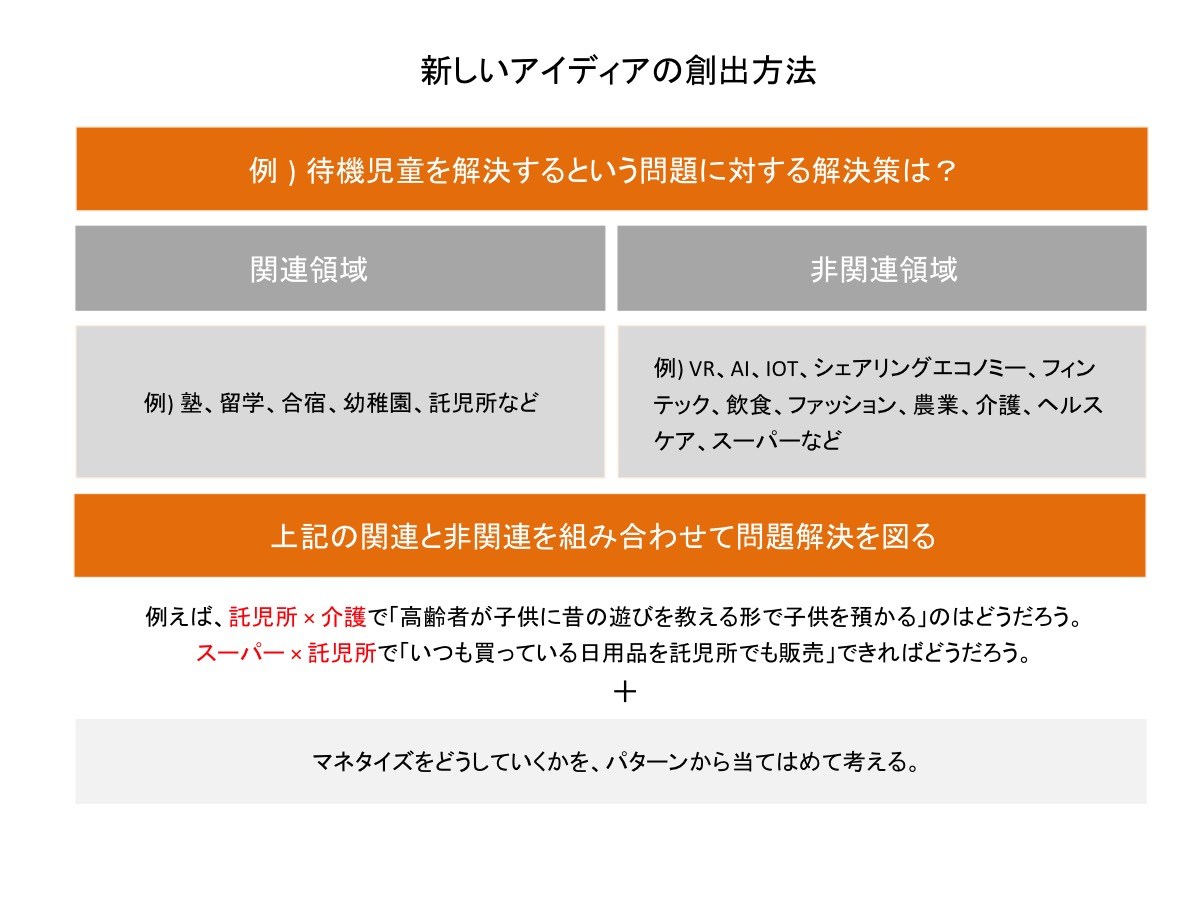
Just by combining two domains to solve a problem, various ideas are born.
If more domains are gathered, a vast number of ideas will emerge.
You just need to select from the above and realize the ideas that seem viable as a business.
No special talent is needed to generate innovative ideas.
It's a good story if you already have the premise of combining two domains to solve a problem.
By the way, some people might say they tried it but couldn't come up with any ideas.
That's because they lack the prerequisite knowledge.
I recommend reading homepage magazines and books daily and routinely gathering various information.
Don't limit yourself to business; thoroughly collect information about new and interesting things.
As knowledge accumulates, business domains and solutions will quickly connect.
It's a matter of how much information you have in your head.
Attach a monetization method to the idea.
Once you've reached this point, all you have to do is think about where to generate sales.
Even if an idea comes to mind, it's meaningless if it doesn't lead to sales.
Please refer to the content explained at the beginning for monetization points.
For example, let's say we adopt the idea of cram school × nursing care.
It's a plan to connect seniors and children, and have children looked after while running a play-based cram school.
Now, let's consider how the above can be monetized.
How about receiving payment for providing the service?
This is the most realistic option: set a daily fee and allow participation.
It's similar to a typical cram school.
How about monetizing through advertising by publishing on blogs and media?
This would be the case if interactions with children could be turned into media, like articles or videos.
It seems difficult on its own, but there might be a way.
If realized, there wouldn't even be a need to receive money from parents in the first place.
There's also a possibility of creating a completely free daycare center.
How about monetizing through a monthly subscription after member registration?
This form is called a subscription.
Recently, subscription-based businesses have increased.
Even restaurants are sometimes offered on a subscription basis these days.
What about a system where the monthly price is in the range of several thousand yen, and you can drop off your child precisely when you want to?
It would be good to set a limit on the number of times a child can be dropped off per month.
This might be perfect for people who want to drop off their children occasionally, not every day.
What about monetizing by selling products?
This seems difficult, but it might be possible by selling things made with children.
Create something with seniors and sell it as a product to the community.
What about creating a platform and monetizing through brokerage fees?
Given the restriction of seniors and children, it seems difficult to do it solely online.
It might be possible if intermediary staff are involved to match seniors and children.
What do you think?
Why not try implementing all monetization methods, rather than just choosing one?
After that, it would be good to offer the service on a trial basis and experiment to see if it actually works.
If it actually works out, then you can just expand it as is.
Erase the concept of 'impossible' and think about how it can be done.
Have you somewhat understood how to create business ideas?
By the way, what is written here is also my own original idea generation method.
It's a perfect method for generating an infinite number of ideas, so it's worth trying.
However, when thinking like this, a common phrase often comes up.
'It's a good idea, but it's a bit unrealistic.'
Many people say this as if it were a cliché.
Let me be clear.
It's a loss the moment you enter with the mindset of 'it's impossible'.
You shouldn't use the word 'impossible,' or rather, let's erase this word from our minds.
Too many people are not accustomed to thinking about how to make things possible.
In fact, if you 'make it possible,' it will become a business.
If it's a good thing, you just need to think about how to make it possible.
If you do the right thing, it will sell.
Why do you assume it's impossible and give up there?
For example, let's say there was a business idea to combine a nursing home and a daycare center.
I'll say this because some people might misunderstand, but this is just an example.
As for its feasibility, I don't know if it exists.
However, even if it were possible, the people on site would undoubtedly say 'it's impossible'.
In reality, there are countless reasons why it can't be done, such as operations or human resources.
That's natural; it hasn't been done until now precisely because there are countless reasons why it can't be done.
But if combining a nursing home and a daycare center can solve a social problem.
It's definitely better to do it.
To make it possible, you should improve operational efficiency or introduce systems.
If the laws are difficult, you just need to think of a way to comply with the same concept.
If there are no rules there, you should create the rules from scratch.
Everything that humans can imagine becomes reality.
Especially if it is 'right,' it will undoubtedly come true eventually.
Despite this, why do we stop making progress due to immediate operational problems?
Isn't it true that the better environment that emerges afterward offers many more benefits?
People only see what's right in front of them, more than they realize.
They are good at dismissing business ideas that might be possible with effort as impossible due to immediate disadvantages.
Especially given the Japanese temperament, I understand that actions that disrupt past order are not accepted.
However, precisely because we didn't do that, Japan is now weakening.
After all, despite all the disadvantages returning to oneself.
Why is the disparity widening so much now?
Why is it progressively weakening?
Why is poverty spreading?
It's because we ran away from immediate change, deeming it impossible.
It's a manifestation of the result of despising and underestimating inventions made overseas as 'nothing special'.
It's no longer a situation where we can say 'it's impossible' or 'we can't do it'.
Actions that make correct business ideas possible are absolutely necessary.
The combination of monetization and business ideas mentioned earlier is also true.
It might be impossible, but I considered all patterns for how to achieve it.
Then, sometimes you might think it's surprisingly good.
In everything, if you explore the possibilities, you might surprisingly find treasure there.
After exploring all possibilities, you just need to choose the best idea.
I want you to completely discard the word 'impossible' from your mind.
If it's a good thing, I want you to think about how it can be realized.
You must do the right business idea in the right way.
Thinking about what a service or product will look like 100 years from now can spark ideas.
As a bonus, I'll share another method for generating business ideas.
What do you see when you look around you right now?
You probably see various products and services, but I want you to use your imagination a little.
What will all of them be like 100 years from now?
It's impossible for everything to have the same form and role 100 years from now.
Our lives will become more convenient, and their uses will have completely changed.
So, assuming everything evolves in 100 years, how exactly will it evolve?
Please use your imagination a little about the shape of the future.
For example, what will tables be like 100 years from now?
Compared to Japan 100 years ago, the appearance and functions of tables have diversified.
They will be even more diversified 100 years from now.
What will chairs be like 100 years from now?
They might be able to accommodate a wider range of postures.
What about the lights on the ceiling?
How will internet services evolve?
How will TVs and air conditioners evolve?
Every single product will change its form.
When imagining things 100 years from now, there is one core idea.
That is, all products will become "essentially" more convenient.
For example, a chair is for sitting.
If so, it will specialize in sitting, achieving the best possible sitting experience.
What exactly will be the best sitting experience required 100 years from now?
A table is used for placing things or working.
If so, what would be the best table specialized for placing things or working?
What will be the answer to the best table required 100 years from now?
In other words, things inherently have uses, and they specialize according to those uses.
If you consider the "final form" for each use, the answer will naturally become clear.
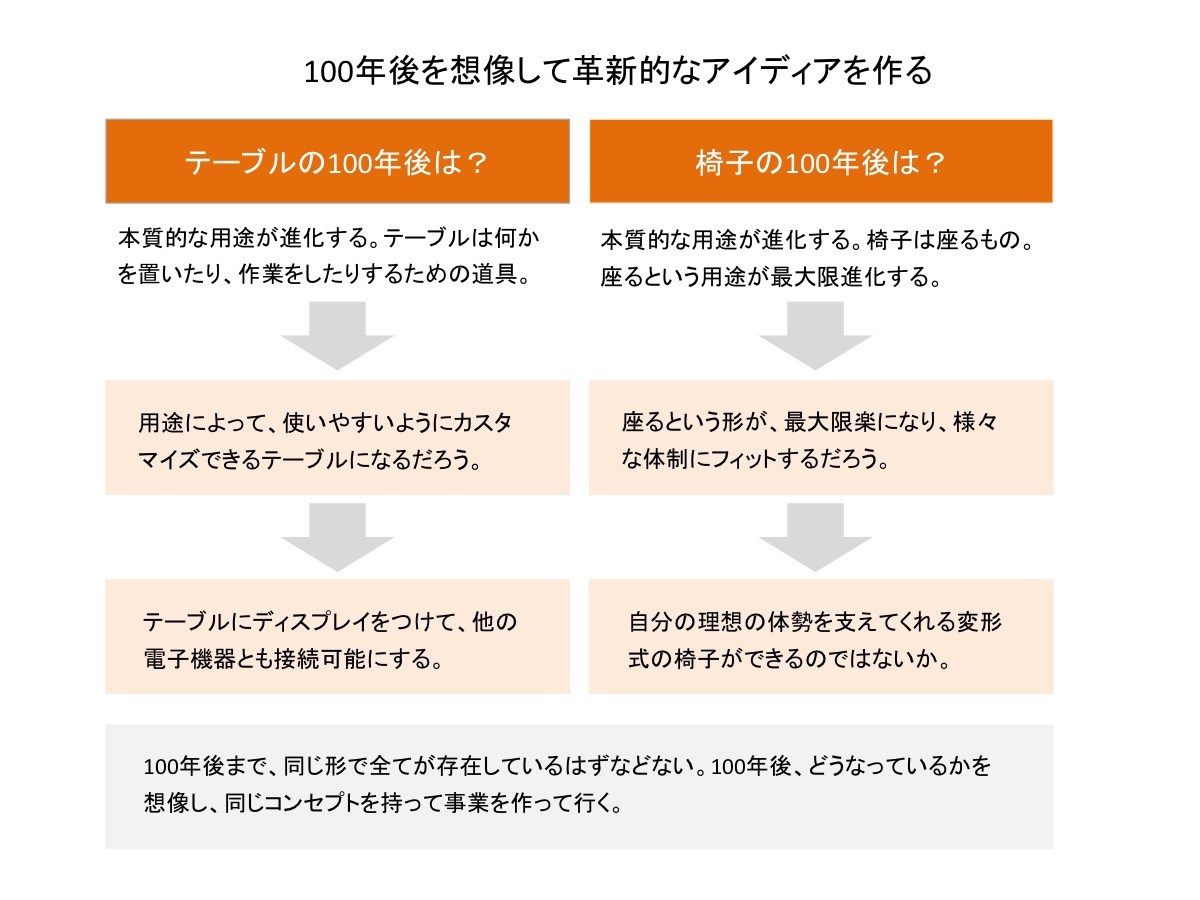
The final form envisioned 100 years from now becomes a business idea.
If you come up with something, a "concept" should be born.
For example, TVs will become thinner and thinner, and you'll be able to watch them anytime, anywhere.
The screen can freely change size, and it's smooth to carry.
Make it large when watching with everyone, and small when watching alone.
The form it takes might be VR, or it might be AR.
Perhaps it can be displayed freely in front of your eyes like a hologram.
The theme is "a TV that's easy to carry and can freely change size."
It might be realized in the form of hardware, or it might be software.
Let's think about how to realize the idea that was born.
And it's fine to gradually decide starting with what can be done now.
A breakthrough should become visible while you're struggling.
You just need to start moving so that you can realize the theme.
Imagining products and services 100 years from now can lead to new business ideas.
Try to strongly visualize it, as if you were writing a science fiction novel.
What humans can imagine will eventually come true.
The world you imagined will also eventually come true.
Coming up with business ideas is easy. There's value only when they are realized.
How was it?
This time, I've explained the general way to create business ideas.
Even if you can't do it at first, after trying a few times, you'll be able to freely create business ideas.
It's good to try it relaxed, without being too tense.
Imagining unknown possibilities is fun.
It would be good to think about it while enjoying yourself, perhaps while taking a shower.
I often come up with ideas while taking a shower too.
However, people cannot succeed just by coming up with good ideas.
Some people confidently say, 'I have ideas,' but it's meaningless.
Previously, there was someone who tweeted on X (formerly Twitter), 'Won't you buy my idea?'
The point is, there's no such easy business.
Why should one buy something that anyone can create infinitely with a little training?
People pay money to those who can make things happen, not to those who merely fantasize; it's utterly meaningless.
Instead of resorting to something as petty as selling ideas, just realize them yourself and show them.
If your true thoughts and will are genuinely there.
Business ideas can only demonstrate their value by being realized.
Let's stop foolishly shouting 'I thought of that too!' when someone else has accomplished an idea.
It's certain that the person who realizes an idea will be recognized more than the person who merely thought of it.
Because realizing an idea is overwhelmingly more difficult than just conceiving it.
If a business idea comes to mind, start acting on it immediately.
Take a step forward and gradually give it shape, even starting from what's close at hand.
Even if you build it clumsily, the possibilities will expand.
It's okay if it's not perfect at first.
As you earnestly walk that path, more people will come to support you.
People who will push you forward and guide you will also appear.
It's okay to be clumsy, it's okay to be awkward.
In any case, struggle and give shape to your ideas.
The moment that changes your life exists only beyond that point.
WRITTEN BY
上山 翔太
2007年からWEBデザイナー / エンジニアとして活動を開始。2015年には、セブ島にて立ち上げた日本人対象のクリエイター育成スクールと運営していたメディアを売却。その後、アメリカで事業デザインを無理やり学ぶ。帰国後は起業家育成プログラムを立ち上げ、新規事業開発、起業家育成に従事するほか、マーケティング戦略策定、ウェブ開発技術を提供。「IT留学シェアハウス」や「起業教育・支援プラットフォーム」を開発、運営。その後、株式会社QUONを立ち上げ。WEB制作事業を軸として、クリエイターと起業家を産む村づくりプロジェクトなどをバリ島と日本を中心に推進。


