
Pop-ups and subscriptions. The changing food and beverage industry.
5 MIN READ
Among the areas I'm interested in, there are restaurants.
However, when I say restaurants, I don't mean ordinary restaurants.
In recent years, new types of restaurants have begun to appear.
There are opportunities precisely in industries that have seen no change for a while.
I myself have recently been contacting chefs frequently.
It's quite enjoyable to devise new models by combining them with IT.
At first glance, IT and chefs might seem like complete opposites.
New ideas are born when seemingly unrelated industries are connected.
It's exciting to try and bring change to industries that haven't seen any.
Today, I'd like to introduce two new types of restaurants.
Those who are planning to open a business in the food and beverage industry should take a look.
Pop-up Restaurants
They've been around since about 2010, so many people might already know about them.
Pop-up restaurants are basically restaurants that don't have a fixed location.
Skilled chefs open in completely different locations each day.
They can be held anywhere as long as there's a place to cook.
They are often membership-based, and the time and location are announced in advance.
Once notified, you make a reservation immediately and head to the venue on the day.
Chefs can easily host them, and it offers a new dining experience for customers.

Pop-up restaurants, which can be easily hosted, are also effective for 'experimenting' with new businesses.
An experiment is a test conducted before opening a new restaurant.
This idea is similar to how products are developed in the IT industry.
Basically, in the IT world, products are not fully developed from the start.
First, a minimum viable product (MVP) is created and tested in practice.
Then, the product is developed incrementally while making adjustments.
Pop-up restaurants allow for similar experiments in the food and beverage industry.
First, open a pop-up restaurant that embodies a minimal concept.
While observing reactions at the pop-up restaurant, gradually adjust the business and concept.
This method eliminates the need to take on significant risk by opening a physical store from the outset.
You can open a store only after you are confident that your concept is accurate.
Open a restaurant 'after trying it out a bit'.
A similar trend will continue to spread in the future.
More and more businesses will be able to be started minimally and easily.
The form of starting a business small and easily should increase in other industries as well.
I feel that business creation is becoming increasingly accessible.
Subscription
Subscription refers to a fixed-rate billing system.
Instead of paying for each meal, more restaurants are operating on a monthly subscription basis.
It's a model developed mainly in the US, indispensable for the future of the food and beverage industry.
Recently, a subscription-based cafe was also born in Japan.
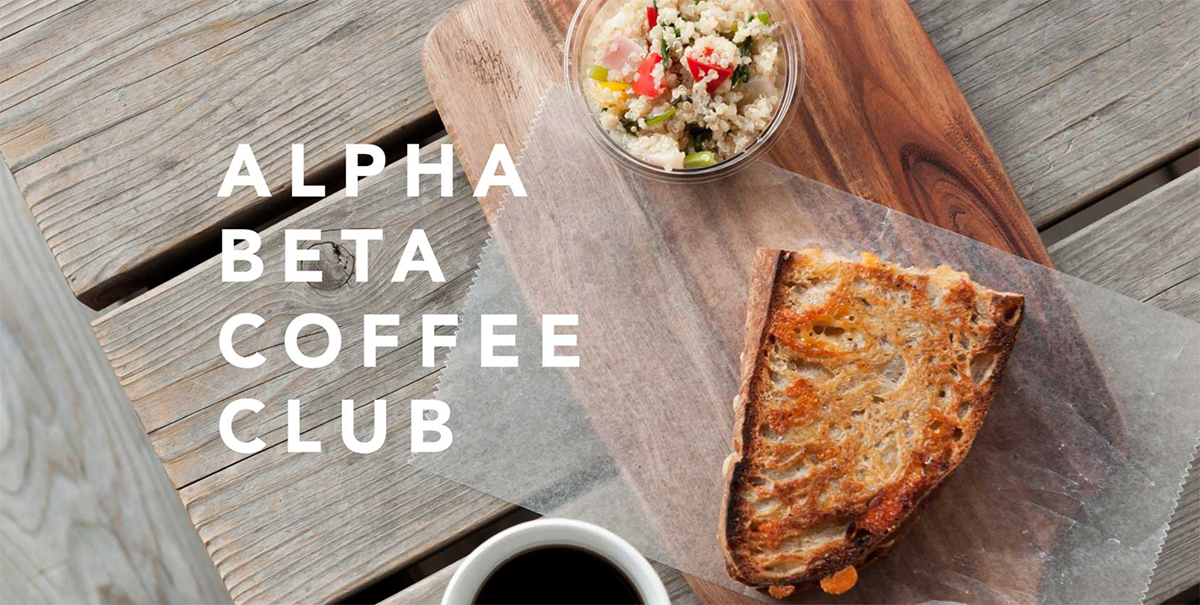
A cafe created by former Google employees,ALPHA BETA COFFEE CLUBthat is.
It's a service where you can drink unlimited coffee for a monthly flat fee.
It opened in Jiyugaoka on April 22, 2017, so it's worth a visit.
They are already considering a second store, which is said to open in the East Tokyo area.
Originally, the concept of flat-rate billing is common in IT.
Everything is offered on a flat-rate basis.
However, in subscription-based businesses, usage frequency is key.
Since it's a flat-rate service, you want to get as much benefit as possible within that flat rate.
That's something everyone naturally thinks about.
Therefore, when applied to restaurants, a community-based approach is fundamental.
Because if it's not in a place you can visit frequently, you won't receive the benefits of the flat rate.
If I were to run a subscription-based restaurant, I would rush to open new branches.
Open in multiple locations to increase places where it can be used continuously.
Or, create a system that can be used frequently.
For example, by being closely tied to a community, or by serving as a meeting room or office alternative.
It depends on the approach, but there are more hurdles to overcome than with IT subscriptions.
However, if a successful model can be established, one could become a pioneer.
There's no doubt that it's a very enjoyable field to challenge.
Summary
Bringing common sense from the IT industry into other business sectors.
This way of thinking is very effective when building a business from now on.
Even in the food and beverage industry, there is still room for reform.
For a while, there were no major changes to the food and beverage industry model.
This is because legal barriers, such as the Food Sanitation Act, have hindered its expansion.
However, it is also undeniable that it has simultaneously protected people's safety.
It is certainly a field where it is difficult to bring about change in Japan.
However, if even one change can be made, it will be a huge advantage.
That is why there is a global movement to create new forms of dining.
Looking at other industries and business models, there are many things that can be applied to food and beverage.
Let's broaden our horizons and see what kinds of work styles exist.
Hints are always found in other industries, not your own.
Professionals sometimes become so focused that they can only see their own industry.
That's not good; the hints lie in collaboration with other industries.
To survive in today's society, it is necessary to think outside the existing framework.
You won't get hints for new ideas just by thoroughly researching your immediate industry.
Please broaden your horizons and look at the world.
Opportunities and hints are not running away.
It's just that the imaginative power to find combinations is lacking.
Opportunities and hints always exist right in front of you.
WRITTEN BY
上山 翔太
2007年からWEBデザイナー / エンジニアとして活動を開始。2015年には、セブ島にて立ち上げた日本人対象のクリエイター育成スクールと運営していたメディアを売却。その後、アメリカで事業デザインを無理やり学ぶ。帰国後は起業家育成プログラムを立ち上げ、新規事業開発、起業家育成に従事するほか、マーケティング戦略策定、ウェブ開発技術を提供。「IT留学シェアハウス」や「起業教育・支援プラットフォーム」を開発、運営。その後、株式会社QUONを立ち上げ。WEB制作事業を軸として、クリエイターと起業家を産む村づくりプロジェクトなどをバリ島と日本を中心に推進。


