
How to Aim for Top SEO Rankings? 14 Essential Basics for SEO Measures.

26 MIN READ
There is a term called SEO.
Even people not involved in web development have likely heard of it.
It is a method to make your site appear first in search results on search engines like Google and Yahoo.
If your own site appears on the first page, users will visit the site.
SEO is about improving search rankings and increasing user traffic from search engines.
SEO continues to change significantly with the times.
For example, what was common sense five years ago is now unconventional, and it greatly affects search rankings.
We must research and absorb current SEO best practices in real-time.
For example, in February 2017, there was a major update called the Welq Update.
There was a media outlet called Welq that mass-produced articles with unclear content.
Although the content was unclear, Google couldn't accurately assess the quality of the content, and it was ranked highly.
As a result, Welq faced a massive backlash and disappeared, but Google did not overlook this incident.
It strengthened its algorithms to avoid handling low-quality articles, including those with low credibility.
It is likely that many businesses suffered significant damage from this incident.
Information constantly flows in real-time among those involved in the web.
Many 'outdated' theories are still commonly known.
We hope you will update your understanding of SEO with this article and use it to achieve top SEO rankings.
If you aim for top SEO rankings, link-building focused on quantity is subject to penalties.
A long time ago, there was a belief that it was good to get many 'links' from popular sites.
This is what is generally referred to as off-page SEO.
In the past, it was certainly an effective method and would have influenced search rankings.
However, now, 'links forcibly acquired to raise rankings' can be subject to penalties.
On the contrary, it could lead to a decrease in search rankings.
External links are those 'naturally posted by people interested in the content'.
The correct understanding is that they naturally become a 'pathway for user traffic'.
Their number and quality are not for getting many links posted to raise search rankings.
Furthermore, links from 'high-quality sites' are necessary.
Links from authoritative sites such as universities, government agencies, and well-known experts have a positive impact.
However, links from sites with few articles and unclear content may have a negative impact.
This is because there's a possibility that someone might be mass-producing and posting their own sites.
Google is constantly thinking about what a search engine should be and improving its algorithms.
In other words, 'sites with truly good content' should be at the top.
What happens if you try to forcibly raise only the ranking, despite the content not being significant?
That will be penalized as 'cheating'.
As I wrote earlier, Goole is thinking about what makes the best search engine.
If you consider the essence of SEO, you should think about how you would want it to be when you perform a search yourself.
Now, when you search on Google or Yahoo!, how would you want it to be?
(As a side note, Yahoo! also uses Google's search engine)
We enter some keywords into the search bar and search.
At that time, a lot of information is searched.
Ideally, the site you are looking for should be found on the very first page.
It is a site that contains good, easy-to-understand information that is also supported by other users.
In other words, if you create a site that publishes content that is supported, your search ranking will increase.
In any case, it's all about the content.
There is no factor for a site that forcibly gained links to be evaluated positively.
What kind of links were naturally placed?
What kind of content is it?
Is it 'naturally' supported by users?
The world's top algorithms see through everything.
It is no longer an era where cheating is possible.
Purely improving the quality of content.
Gathering natural links and authoritative links.
This is what SEO top ranking has become.
Updating high-quality articles is an absolute condition for SEO top ranking.
It has been a long time since the terms content marketing and inbound marketing became known.
For both, the basic principle is to prepare content that is likely to resonate with your target audience.
Emphasis is placed on creating an environment where users naturally develop interest.
Until now, the form of selling from the business side was the common way to attract new customers.
This method is called outbound.
However, advertisements appealing from the company side are, so to speak, 'annoying'.
Because it's one-sided, it's common to deliver content that differs from what the user desires.
Even if presented right in front of them, the reaction is weak.
TV commercials, magazine advertisements, and banners on websites, etc., fall into this category.
The correct approach is for users to approach with interest on their own.
For the gathered users, provide products and services as valuable information.
If this form can be achieved, there's a higher possibility users will turn their attention than with general advertising.
That's why we write articles.
Write attractive articles that the target audience might like.
We will appeal to the readers who are reading.
Depending on the method, there might even be cases where readers don't realize it's an advertisement.
Also, articles once written do not disappear from the internet.
Just keep writing articles endlessly and accumulate them.
To that extent, users who become prospective customers of your company will browse the site through the articles.
Basically, if there are many high-quality articles, that many more entry points will increase.
The more you write, the more pathways to the product increase, which is equivalent to that.
However, if you only think about increasing the number and churn out empty articles, it's meaningless.
You must continue to deliver useful information for the lives of those who view it.
In other words, it's about quality.
If there is no quality, having quantity is meaningless.
First, prioritize improving quality, and then aim for quantity.
After that, if you continue to build up, traffic will increase.
Accumulating articles is an absolute condition for achieving top SEO rankings.
I often receive the question of how many characters an article should be.
This can be divided into two answers.
If it's a keyword without competitors, 1,000 characters or more.
If it's a keyword with competitors, it's 10,000 characters or more.
It is also said that the number of characters is not that necessary for search engine evaluation.
Because just because it's long doesn't necessarily mean it's a good article.
That said, what if competitors are continuously publishing good articles?
No matter how good an article is, if there are many similar articles, it's a different story.
If content is extensive and easy to understand, the time people spend on the site will also increase.
If customers stay on that site or page for a long time, that is attractive content.
The content is extensive, but techniques are needed to make them stay without getting bored.
Depending on whether there are competitors or not, the number of characters differs by 10 times.
Furthermore, simply accumulating characters is completely meaningless.
It must be meaningful content, and quality must be guaranteed.
Even if you only accumulate characters, without quality, top SEO ranking is difficult.
Secure authority.
Since the Welq incident, authority has become important for blogs.
It is necessary to clearly state who wrote or supervised this article.
As introduced earlier, university professors, researchers, teachers, government agencies, and governments have high authority.
On the other hand, if there is almost no data online and it's unclear what kind of work they do, their authority is low.
If you are usually treated as an authoritative presence, your authority will increase.
In short, it is important that the person who wrote the article is an expert in that field.
That's why you should definitely create an author introduction area on the article page.
Be sure to write a thorough author's introduction.
If the profile and authority are clarified to some extent, the article will be highly evaluated.
From a technical perspective, structured data should also be embedded in HTML.
Structured data is source code that makes it easier to convey information to Google.
In addition, Google's features may sometimes display the content of structured data during searches.
From now on, the role of structured data will become even more important.
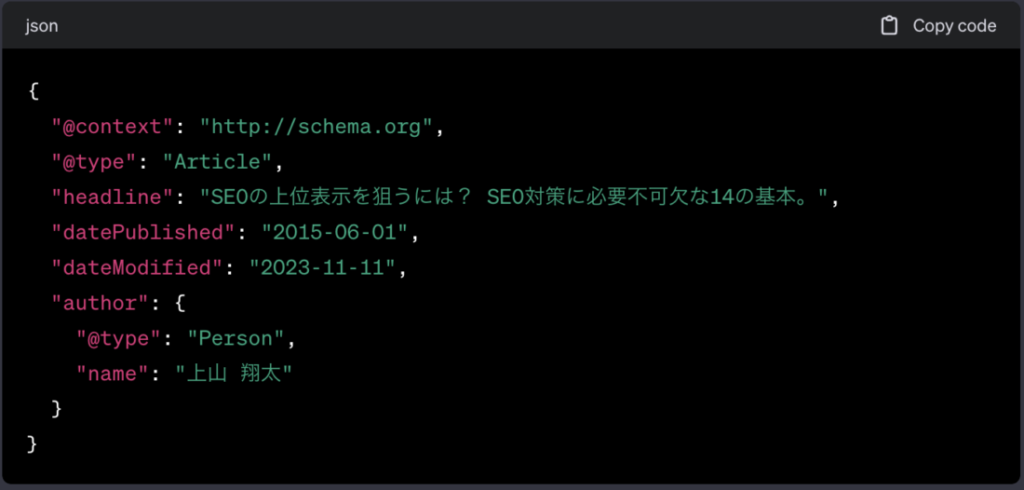
Basically, only people who can handle HTML can implement structured data.
The data itself can be created quickly if you ask ChatGPT.
However, structured data is something that is written directly into the source code.
If structured data is not embedded in your blog, ask an engineer.
Such differences in implementation will affect the site's power later on.
Spreading on social networks also leads to higher SEO rankings.
In fact, the spread on social networks also greatly contributes to SEO measures.
How articles are shared on SNS, mainly Facebook and X (formerly Twitter).
Search engines also properly incorporate what happens on social networks into their rankings.
A while ago, tweets from X (formerly Twitter) also became displayable in search engines.
That update tells the whole story.
The influence on major social networks will also affect rankings.
Note that you can also cheat on SNS.
By creating a large number of accounts, acting as if they are individuals, and then sharing a lot.
In fact, there are many businesses that cheat in this way.
However, recently, user management has also become thorough.
If caught cheating, the account will be immediately frozen.
The fact that user information is managed is also a reason why dissemination on SNS is reliable.
Also, be sure to include social buttons.
These are article share buttons.
It is important to have social SNS share buttons on your homepage or blog.
Articles will be seen by others, and access numbers will increase in a chain reaction.
The genre called 'viral media', which was popular until recently, makes good use of SNS buttons.
Web media that thoroughly pursues how to be 'disseminated on SNS' is called viral media.
Adding 'SNS share buttons' to articles is a standard created by viral media.
As such, in modern SEO, the power of SNS is also considered as reliability.
Content quality and dissemination on SNS are important.
- On your homepage, write articles.
- And then create a mechanism for them to be disseminated on social networks.
- Articles with good content are spread to many people.
- When spread, links are naturally posted, increasing user pathways.
Focusing on the above is the minimum requirement for top SEO ranking.
First, if you have the above understanding, then it's just a matter of how to pursue it.
If you think and think and try to find an answer, the answer will naturally emerge.
Let's provide good content, acquire users, and increase product sales.
The path lies beyond the steady accumulation that creates a good cycle.
However, for top SEO ranking, quantity is also important.
When I say this, the question arises, 'Is it really okay not to consider the number of articles at all?'
The number of articles is still overwhelmingly important.
It is necessary to continue writing articles while ensuring quality.
This is because the key to top SEO ranking lies in keywords.
For example, I once wrote an article about 'Kamome no Tamago' on my blog.
'Kamome no Tamago' is the name of a confection.
Perhaps some people have eaten it.
This was an article I wrote somewhat casually, without particularly focusing on SEO.
The content was about why 'Kamome no Tamago' and 'Goma Tamago' are similar.
It was an article I wrote, wondering why they were similar.
However, after a while, people gradually started coming.
Since I had the chance, I tidied up the format to make it a 'presentable article' and added a little more.
And what do you know, every month, a considerable number of people started visiting from the "Kamome no Tamago" article.
However, even so, the content is not a great article.
It doesn't have a huge amount of text, nor does it seem particularly appealing.
If there was a reason, it was the keyword "Kamome no Tamago".
The theme is to compare it with "Goma Tamago".
If there was a reason, nothing else could be considered.
Perhaps it ranked high in SEO because there were no other significant competitors.
Sometimes you get unexpected traffic from article themes and keywords.
On the other hand, even if you aim for it thinking it will succeed, it can sometimes fail completely.
In other words, ultimately, you won't know until you publish and try it.
If publishing and trying relates to winning or losing, then quantity is absolute.
While ensuring a certain level of article quality, continuously increase the number.
Then, identify articles that are likely to attract a certain amount of traffic, add to them, and strengthen their content.
While quality over quantity is fundamental, it's not to say that quantity is unnecessary.
Emphasizing quantity while improving article quality is important for high SEO rankings.
Add thoroughly. Adding in several installments is key to high SEO rankings.
For high SEO rankings where competitors exist, content quality and quantity are essential.
It is necessary to provide clear, high-quality information with an appropriate volume in each article.
Of course, it's not just about listing; users need to find it easy to read and understand.
However, it would be impossible to write such an article in one day.
Ideas don't continue for a single theme, and it requires an enormous amount of effort.
I myself am like that, my concentration might not last, and it might become sloppy.
What you should remember here is that 'achieving top SEO rankings doesn't happen in a day'.
Write one article and release it for now.
After that, add more content in several stages.
If you add content once, it will probably increase by about 1,000 characters.
If you repeat it 10 times, it will be over 10,000 characters.
Also, since it's not affected by concentration, the content will be high quality overall.
If you write continuously, you gradually get exhausted, and the quality of the content will gradually decline.
However, if you write in several stages with breaks, you can ensure the quality of the content.
When writing continuously, articles often become incoherent in content without you realizing it.
In the first place, it's hard to read and inconvenient for users.
However, if you keep writing while exhausted, you won't even notice such things.
Furthermore, if you write in segments, you won't run out of ideas even for the same theme.
This is because new discoveries emerge over time, even for the same theme.
For example, even with content like 'top SEO rankings,' what you knew a year ago and what you know now are different.
There are insights like 'this was useless,' and insights like 'doing this improved it'.
Every day, people live by noticing something.
That's why it's necessary to take some time and look at it again.
When you reread an article you wrote previously, insights like 'I can write something like this' emerge.
Moreover, there are more than you might imagine.
When I wrote it, I might have thought, 'I can't write any more than this.'
However, over time, ideas themselves are often updated.
Adding to it in several parts is a big step towards enriching the content.
The richness of a single article leads to higher SEO rankings.
On the same blog, I receive the question, 'Is it okay if the article genres are varied?'
While it depends on the purpose of achieving higher SEO rankings, the conclusion is that you don't have to align them.
That said, it's natural that thematic consistency brings results to SEO.
Homepages and blogs each have their own themes.
And users come seeking solutions to problems related to that theme.
Therefore, talking about something completely different would be meaningless.
If you maintain consistency, Google will also consider it a strong site for that theme.
However, if articles from different categories are 'mixed in' to some extent, there's no problem.
This is because, fundamentally, it's sufficient to have an appropriate answer for the searched keyword.
An appropriate answer comes from a single article, not from multiple articles.
Of course, multiple articles can synergistically deepen understanding.
However, you can simply link them as related articles.
If it were necessary to align themes for all articles, general-interest blogs wouldn't be possible.
Yet, in reality, even general-interest blogs achieve a lot of traffic.
It's sufficient to have an optimal solution for each keyword on a separate page.
That said, if you can match the genre, the site's own SEO will be easier to improve.
If you write articles with consistency, you will be more easily trusted.
If your blog's theme is design, articles should ideally align with design.
However, this means it's not a problem if other miscellaneous content is included within it.
To rank articles highly, manage them in a spreadsheet and analyze them quantitatively.
I regret that I should have started managing articles much earlier.
Of course, any tool is fine as long as you can manage with it, not necessarily a spreadsheet.
Without management, hypothesis testing and improvement become inefficient.
It will become difficult to analyze what actions with what keywords had what effects.
I talked about how achieving top SEO rankings is 'not the end after writing an article'.
By frequently adding, correcting, and revising, articles gradually start to rank higher.
However, there's a big difference between actually managing data and not managing it.
What was done before, and how effective was it?
And what measures should be taken this time?
The next steps become clear.
By clarifying what to do to achieve top SEO rankings, know-how also accumulates.
Your own growth will accelerate, and of course, achieving top SEO rankings for articles will also become easier.
- What was done last time?
- And how effective was it?
- What measures should be taken this time?
Managing that progress will be the key to unlocking top SEO rankings.
Also, you can vividly experience the state of Google updates.
What worked last time may no longer be effective, or new concepts may have been introduced.
You should also be able to see how Google is improving and evolving its search engine.
By performing such data analysis, you will be able to learn the methods for achieving top SEO rankings themselves.
Furthermore, regarding management methods, we recommend that you think about them yourself.
By thinking about management methods yourself, your understanding will deepen.
Above all, analysis will become easier.
With a management method created by someone else, it may take time until you get used to the analysis.
If you create it yourself, it will be clear at a glance where to look, and your objectives will be clear.
Please, create your own management method and unravel the mystery of top SEO rankings.
It can be quite troublesome, and many people probably dislike it, but let's try our best to manage it.
Aligning keyword expressions is important for top SEO rankings.
Keywords must match the target keywords.
With similar keywords, sufficient relevance to the keywords users search for will likely not be recognized.
When writing articles, there can be countless similar keywords.
For example, multiple keywords such as 'method' and 'technique', or 'light' and 'radiance', are often seen.
These keywords should be unified into a single expression.
For example, let's unify 'method' and 'technique' into one of the terms.
Let's also unify 'light' and 'radiance' into one of the terms.
At first glance, it seems that having many keywords makes it easier to be searched.
However, if countless similar keywords exist, the main focus of that article disappears.
As a result, it becomes impossible to determine what the article is trying to say.
It must be clearly recognized what the article is talking about.
When writing an article, multiple keywords can gradually become mixed.
Moreover, it's often difficult to notice this while writing.
After writing, thoroughly review the content and unify keywords that can be unified.
Avoid having multiple keywords scattered unnecessarily.
First, rather than aiming for top SEO ranking with multiple keywords, aim for top SEO ranking with a single keyword.
If you want to aim for top SEO ranking with multiple keywords, you can add keywords later.
Furthermore, instead of putting multiple keywords in the same article, you should write a separate article for each keyword.
Keyword unification leads to top SEO ranking and also improves user readability.
For some articles, put effort into trial and error with the mindset of 'This article will definitely achieve top SEO ranking'.
As long as you are implementing measures to 'somehow' rank all articles, access will not increase.
Focus on a few important articles and conduct thorough trial and error to ensure they achieve top rankings.
Collect numbers and data, and observe quantitatively.
It is important to check one article daily and thoroughly experiment with how to achieve top SEO ranking.
Even if you try to achieve top SEO ranking for articles generally, it will ultimately remain half-hearted.
As a result, you will accumulate efforts without knowing at all what was good and what was bad.
Of course, that's not to say that once you write an article, you should endlessly focus on just that one article.
Among the articles that are continuously being added, choose the ones that "will definitely rank high in SEO."
Select multiple articles to focus on and repeatedly make thorough additions and revisions.
When focusing on a small number of articles, changes become easier to observe.
As a result, it becomes easier to understand how SEO high rankings were achieved.
However, when adding to and revising several articles, it is necessary to formulate a "hypothesis."
Formulate a hypothesis, assume "this might improve it," and then test the hypothesis.
As a result, verify whether it succeeded or failed.
The difficult aspect of achieving high SEO rankings is that results do not appear immediately.
SNS distribution and email distribution show immediate results.
However, for high SEO rankings, the implemented measures truly bear fruit after some time.
That is precisely why it is important to properly manage articles.
Decide on several focus articles and repeatedly revise and add to them.
Formulate a hypothesis and repeatedly make revisions in a way that tests the hypothesis.
Properly manage articles and quantitatively analyze the results of the hypotheses.
As a result, it becomes clear what needs to be done to achieve high SEO rankings.
Once you understand the tips for high SEO rankings, all that remains is to apply them to other articles.
Continuously implement the same measures to promote high SEO rankings.
What everyone wants to achieve comes with a lot of effort and hurdles.
If you neglect such efforts and accumulation, your goals will never be realized.
Let's accumulate small things every day.
Keep your heart strong and continue learning every day.
The reward for that effort is a top SEO ranking.
Articles start to attract organic search traffic after 3 to 12 months.
There probably isn't much marketing that shows results with such a time lag as SEO.
It is often said that blog and article traffic grows like a growth curve.
A growth curve generally starts with a gentle upward trend and then sharply rises in the latter half.
SEO is said to be the same, and looking at the analysis data, the reason becomes clear.
For example, let's say you wrote a very high-quality article first.
Let's say you put in a lot of effort for one or two months and wrote about 200 articles.
Of course, you must not only write many articles but also ensure their content is solid.
However, these do not produce immediate results.
There is definitely a time lag of about 3 to 12 months.
Please look at the graph below.
This is a graph of articles that are currently attracting a fair amount of traffic to my blog.


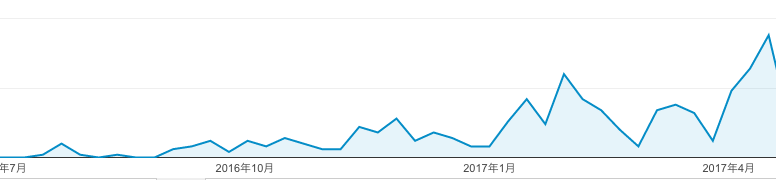
Looking at any graph, they all show a sharp increase after about six months to a year.
As for what I did during the period of growth, I did nothing.
I simply continued to implement similar SEO measures steadily.
Even without doing anything, if I waited, one day it suddenly started to grow rapidly.
This might be a Google algorithm change, or it might have suddenly been evaluated positively for some reason.
I don't quite understand the reason, but it suddenly gained recognition and started to grow.
Most of the articles currently generating traffic are like that.
If left alone, they suddenly started to grow rapidly within 3 months to 1 year.
In the first place, no matter how good an article you write, it usually takes several months to be evaluated.
Therefore, it is important to continue posting without giving up.
If you write good articles and they continue to be evaluated, they will suddenly start to grow rapidly one day.
That is the timing when the good articles you initially accumulated are evaluated.
That is why you must continue to post good articles every day without giving up.
As long as you keep posting, a moment will come when the entire article suddenly starts to be evaluated.
There is almost always a time lag until evaluation.
Please, everyone, keep writing and accumulating good articles without giving up.
If you do so, the time when you are rewarded will surely come.
Link Search Console to Analytics and check keyword search rankings.
By linking Google Analytics and Google Search Console, you will be able to obtain keywords.
You can find out what words were searched to reach your homepage.
Search Console is where you register your homepage's URL and sitemap.
Inform Google of your homepage's existence in advance through Search Console.
Then Google will quickly detect the registration, addition, or changes of your page to the search engine.
What you can do with Search Console is tell Google that your site has changed.
This Search Console actually accurately acquires search keywords.
Furthermore, it contains not only keywords but also complex information such as search rankings.
By linking Search Console to Analytics, you can get more detailed information.
The method of linking is very simple.
While logged into Analytics, click the URL below.
On the page, there is a button that says 'Link Properties', so click it.
Simply follow the instructions and proceed with the settings.
Property Linking
https://support.google.com/webmasters/answer/1120006?hl=ja
After linking with Analytics, you can check keywords from Analytics.
By the way, nothing will be displayed at the moment of linking.
If you leave it for a while, eventually past data will be reflected.
Even if all data is zero, it's good to wait calmly.
In search queries, in addition to keywords, you can also see the search ranking of keywords.
For example, if you wrote about Shibuya, you can check what rank it appears at if you search for 'Shibuya'.
However, it is limited to keywords that someone directly searched for and arrived at your site.
Furthermore, you can also see the click-through rate and impressions.
If you can see this much, you can analyze as much as you want.
To analyze thoroughly, the number of posts is also necessary, so try to post diligently.
Keyword analysis is an essential item, so if you are aiming for SEO, please be sure to set it up.
Pay attention to impressions and clicks.
When looking at search queries, a phenomenon occurs where impressions are high but clicks are low.
This is one of the signs that you can easily increase traffic.
Let's consider what it means to have many impressions but few clicks.
In other words, the title is not appealing, or it doesn't meet the search user's needs.
Even if it ranks high, if it's not clicked, it's completely meaningless.
If it's displayed on the first page, we want to achieve an average click-through rate of 10%.
If it's displayed 300 times, we want it to be clicked at least 30 times.
If you improve the title, access might suddenly increase starting tomorrow.
Compared to other measures, it's easy to see results and can be said to be a straightforward method.
Of course, this assumes that there are articles ranking high.
However, if you just improve it blindly, you cannot maximize its effectiveness.
You need to record how much change there was before and after improvement.
So, let's try creating data like the following in a spreadsheet.
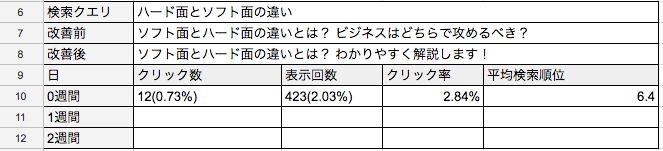
This is a table for monitoring data changes weekly.
The search query is the search keyword, and we compare the title before improvement and the title after improvement.
If you monitor changes weekly, you can know how much change there was.
Steady data confirmation and improvement will eventually produce great results.
Basically, let's aim for a click-through rate of around 10%.
Even with the above data, if you increase 2.84% to 10%, the number of accesses will increase by nearly 5 times.
Something with only 12 clicks will increase to about 50 clicks.
If just improving the title can change the effect so significantly, there's no reason not to do it.
If, despite writing a large number of articles, access is not increasing.
It would be good to try it.
WRITTEN BY
上山 翔太
2007年からWEBデザイナー / エンジニアとして活動を開始。2015年には、セブ島にて立ち上げた日本人対象のクリエイター育成スクールと運営していたメディアを売却。その後、アメリカで事業デザインを無理やり学ぶ。帰国後は起業家育成プログラムを立ち上げ、新規事業開発、起業家育成に従事するほか、マーケティング戦略策定、ウェブ開発技術を提供。「IT留学シェアハウス」や「起業教育・支援プラットフォーム」を開発、運営。その後、株式会社QUONを立ち上げ。WEB制作事業を軸として、クリエイターと起業家を産む村づくりプロジェクトなどをバリ島と日本を中心に推進。


