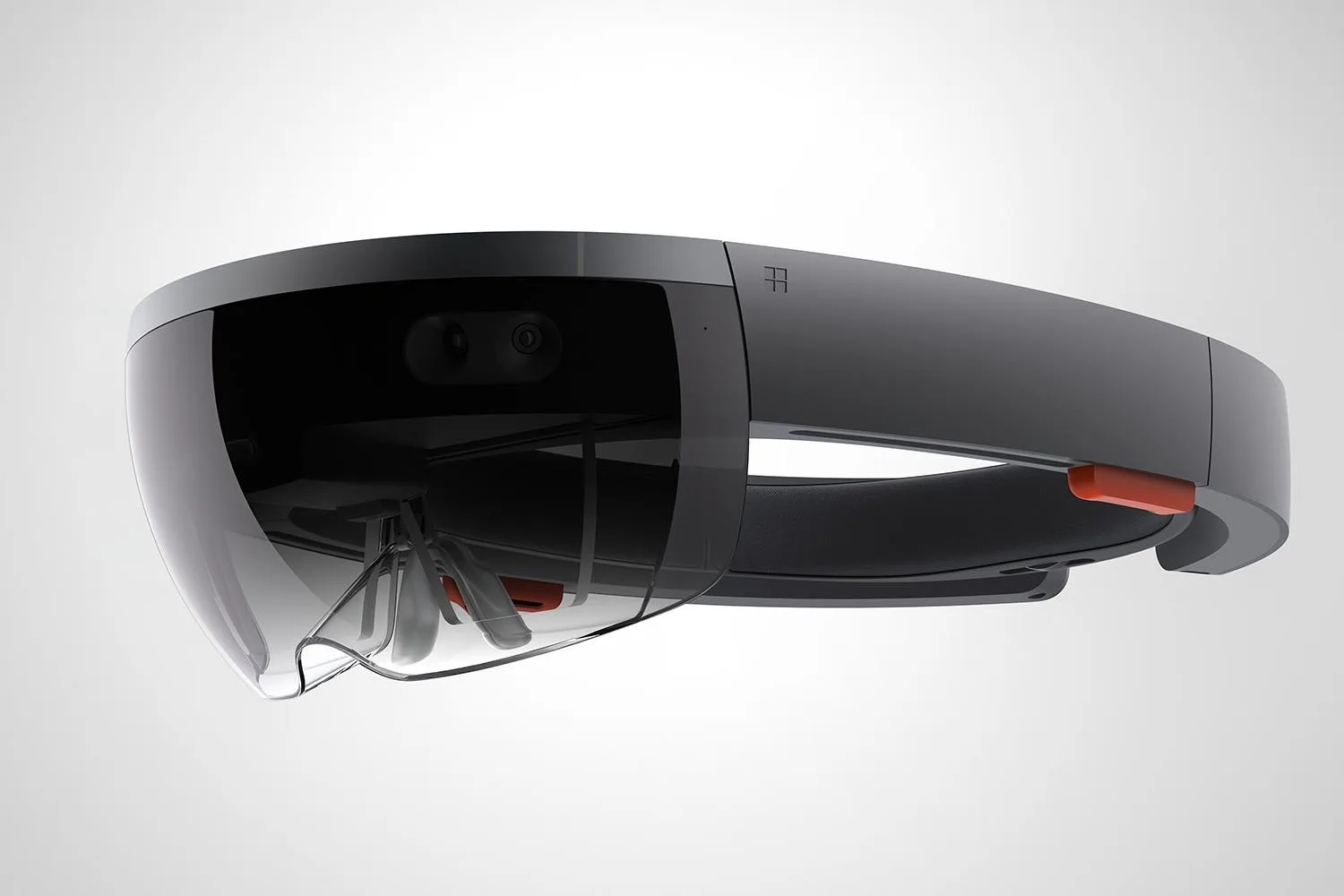
The near-future way of working is right there. New workflows created by HoloLens.

12 MIN READ
Do you know about VR headsets? It's a technology that's been talked about a lot recently, so many people probably know about it. It's a device that you wear on your head, covering your eyes with something like large sunglasses. When you put on a VR headset, images are displayed inside the headset in front of your eyes, allowing you to enter the video with a 360-degree, full field of view. Not only straight ahead, but if you look right, you see the right image, and if you look left, you see the left image, as if the virtual world is superimposed on the real world. It's a technology that makes you feel like you've wandered into the world of a sci-fi movie.
Headsets are also being developed in Japan. Everyone knows about the PlayStation game console, right? Headsets for PlayStation have also been announced and can be used in actual games. The mechanism is not much different from Oculus headsets. These headsets will be released in 2016, which means next year from the perspective of 2015. This means that from next year onwards, games may become something played by wearing a headset on your head and within a 360-degree field of view.
Anyway, it's easier to understand if you just watch it once.
VR headsets are gaining popularity, primarily centered around gaming. However, recently, a headset was announced that goes beyond the gaming framework and can be fully utilized in both daily life and work. It was announced by Microsoft. Its name is HoloLens. This device breaks out of the gaming world and merges virtual reality with the real world. I imagine you might not understand what I'm talking about, so for now, please watch the video below.
Well, what do you think? Virtual reality and the real world are merging beautifully. Originally, there was a concept called AR. It's expressed by the term Augmented Reality. Extending reality. In other words, making reality more convenient with the power of digital technology.
Beyond AR (Augmented Reality) to MR (Mixed Reality).
A few years ago, an application called Sekai Camera was distributed on smartphones. Sekai Camera was a system that allowed users to leave comments and data at a 'location' when viewing the real world through the smartphone's camera function. In other words, for example, if you went on a trip and launched the Sekai Camera app at that location, the camera would first start up. It's like looking at the world through a camera. If you leave a comment on your smartphone there, other Sekai Camera users can see the comments left behind through the app.
The concept of superimposing virtual reality onto the real world, like Microsoft's newly announced HoloLens, already existed. However, many ideas lacked practicality and never became widespread. HoloLens, however, achieved an extension of reality far beyond what Sekai Camera offered, creating a quality that can actually change the way we work and live. This technology, which superimposes reality and virtual reality at a high level, goes beyond the concept of AR and reaches the concept of MR (Mixed Reality).
HoloLenz also comes with Windows 10.
By the way, HoloLens itself is equipped with Windows 10, meaning it can function as a PC on its own. What this implies is that it will likely further change the traditional concept of personal computers. At this stage, it is expensive at $3000, so it will probably be sold as a product for professionals. Rather than paying $3000 for a mere game console, it's more like a professional purchasing a new high-spec PC, otherwise, it's hard to justify. In other words, in the initial stages, it will likely be used in ways most compatible with professional work.
You might get a rough idea by watching the video above, but it has a particularly high affinity with 3D. For flat design and work, there probably won't be that much difference in the work itself.
However, all the "displays" that current computers have will be reproduced in 3D space. Of course, it's highly likely that computer work screens will also be sufficient within virtual reality. Since it's equipped with Windows 10, you'll naturally be able to use software like spreadsheets and Word, and with just one HoloLens, you can open a virtual reality display on the spot and work without carrying a physical display.
While it's true that you can't really say anything until you actually use it, it's safe to say that it already possesses sufficient functions and possibilities to complement an actual computer. In other words, HoloLens indicates the possibility that the computer that every household currently has will be replaced entirely by a head-mounted display.
HoloLens eliminates the need for any displays. You won't have to carry a computer either.
And a major possibility is that all displays will become unnecessary. With HoloLens, it's as if we've entered the display itself. The space itself becomes the display, and various applications are launched within it. Even with current computers, various applications are launched within the display, but with HoloLens, all of them can be placed anywhere in the real space, using it as a stage.
To begin with, displays will no longer be needed in rooms. Previously, purchasing a huge display would incur hundreds of thousands of yen in costs. However, in virtual reality, the size of the display is completely free. If you open a video player on a computer, you can freely change its size, but if you overlay that action onto reality, even the size of a super-large TV can be reproduced in virtual reality.
After the iPhone was released, CD Walkmans disappeared. Records also became something only enthusiasts would buy. This is because music began to be sold and consumed as digital data. Displays themselves are also becoming digital data, and if they become widespread, the display itself might eventually become something only enthusiasts use. Of course, at this stage, the price is high, and as long as it doesn't support multiple people viewing, displays won't disappear. However, for personal tasks, especially if you're okay with enjoying it alone, one HoloLens might be enough.
Especially by handling 3D and real objects simultaneously, many work methods will change.
As shown in some demos, industries that can improve work efficiency by handling 3D will see significant changes. For example, architecture.Confirming the building's structure, atmosphere, and all detailed parts in 3DThis will allow both the creators and the clients to deepen their understanding. If the building's structure can be intuitively modified, clients might even be able to physically touch it and convey their wishes.The same applies to medicine.It will be easier to communicate by reproducing exactly where and how something is wrong inside the body in realistic 3D right before your eyes.
Speaking of buildings,For example, buying a house.Visiting model rooms used to be the norm, but from now on, it will be enough to go to a square room with HoloLens. If you cover the entire room with a 3D model, the room will be complete in an instant. Moreover, in the next moment, you can change it to a completely different interior. This means that when selling houses, there's no need to create model rooms, and even if you don't actually visit the site,Reproducing the interior and property details meticulouslyThis will allow customers to better visualize the property. Then, they only need to visit the properties they are actually interested in.
Also,Experiencing places you can't actually visitwill be possible. For example, Mars. While we can't go directly to Mars yet, it's possible to cover and reproduce its surroundings in 3D. Furthermore, by deploying distant spaces on Earth in 3D around us, we can feel the local space more deeply. This, for example,tourism industrycould also be used for presentations. For example, content that previously could only be conveyed by showing brochures and describing the local situation can now be experienced firsthand, allowing for a more immersive feeling.
Also,design of machines with complex structures like motorcycleswill also be very useful. If, instead of showing it on a computer screen or in a catalog, a realistic 3D model can be displayed right in front of you, and you can intuitively work on it on the spot, things will move quickly. Especially in design, from subtle adjustments to color conversions, work can proceed with a deeper understanding. Once 3D printers become widespread, it will also be possible to intuitively create 3D models right in front of you and print them with a 3D printer. In the actual demo, a 3D model of a drone was easily created right in front of us. The rest, I suppose, is just printing it.
What if a camera capable of projecting one's own image were to be released in the future and could be linked with HoloLens?meeting methodswill also change. Just like in Star Wars, you'll be able to make the other person appear as a hologram in front of you and converse with each other. Furthermore, it will be possible to display actual products in front of you and use them as reference materials. By displaying products or substances that are not actually at hand as 3D objects in front of you, you can deepen your understanding. In other words, even if it's not actually in front of you, what was previouslyonly conveyable through photos or images can now be displayed in front of you to advance discussions.This is a groundbreaking advancement.
mail order and online shopping methodsmay also change. For example,purchasing a sofa. Currently, when purchasing a sofa online, people measure the size themselves before buying. However, if HoloLens could be used, you could download a life-sized 3D model of a sofa and actually place it in your room. The same goes for curtains, chairs, and tables. For furniture and products whose true nature is unknown until purchased, by overlaying virtual reality, you can easily understand their size and atmosphere before buying. You could even,actually place 3D furniture in an empty room before making a purchase.That's the idea. If this method is applied, all kinds of online shopping and mail order will change.
spatial production for stages and eventsHow about that? If a simulation is actually created in 3D, its scale and feel can be understood instantly. Integration with Bluetooth and other devices is also exciting.car navigationwill also become unnecessary. Often, when you buy products at large shopping centers like IKEA, there are furniture items that you have to assemble yourself. In that case, by actually displaying the parts as holograms in front of you, you can see where and how they connect, and so on, thatassembly methodyou will be able to understand immediately. And,gamesit's possible to play games set in the real world, as shown in the demo. Above all, more talented and imaginative people will,come up with even more diverse ways to use itand release them as HoloLens applications to the world. Honestly, the uses I've presented so far are just the beginning, and many creators will emerge to propose even more optimal ways to use it.
Summary
For now, HoloLens appears to be for single-person use. If you output to another display, you might be able to share the space, but in reality, we want to share the space with superimposed holograms. Therefore, what is eagerly desired is a goggle that simply shares and displays the images projected by a single HoloLens in front of you. It doesn't have any particularly difficult functions; it just needs to share the space projected by HoloLens. If the main unit costs $3000, it's not feasible to buy multiple units. So, I wonder how great it would be if there were goggles that simply shared the visual space. That way, the whole family could enjoy movies on a giant screen.
Additionally, by connecting to a webcam that projects the person using HoloLens, the possibilities will expand even further. If you could experience the video being captured by HoloLens in real-time, it would be quite interesting. When making a call to someone, if you want to proceed with the conversation while seeing yourself and the other person, like in a video call. If camera footage could be sent to HoloLens, it would demonstrate numerous advantages as a communication tool. Not just HoloLens itself, but also the existence of its peripheral devices. Whether they are genuine Microsoft products or something else, they will undoubtedly merge with applications and further enhance the appeal of next-generation MR.
Indeed, devices and inventions that seemed to only exist in sci-fi movies are finally being brought into existence today. The pace of global evolution is said to be fast, but from now on, that sense of speed may increase even more. When that happens, if businesses fail to utilize new cultures, knowledge, and technologies at all, and their own workflows fall behind, they will surely be left behind by the world. By constantly paying attention to the latest emerging technologies and services, thinking about how they can be used, learning, mastering, and thoroughly utilizing them, I believe we can accelerate future business and go on the offensive. Among the many inventions, HoloLens is undoubtedly the service with the greatest potential to change the world right now.
WRITTEN BY
上山 翔太
2007年からWEBデザイナー / エンジニアとして活動を開始。2015年には、セブ島にて立ち上げた日本人対象のクリエイター育成スクールと運営していたメディアを売却。その後、アメリカで事業デザインを無理やり学ぶ。帰国後は起業家育成プログラムを立ち上げ、新規事業開発、起業家育成に従事するほか、マーケティング戦略策定、ウェブ開発技術を提供。「IT留学シェアハウス」や「起業教育・支援プラットフォーム」を開発、運営。その後、株式会社QUONを立ち上げ。WEB制作事業を軸として、クリエイターと起業家を産む村づくりプロジェクトなどをバリ島と日本を中心に推進。


