
If you can see your destination, there’s nothing to fear! The basics of how to build a marketing strategy.

27 MIN READ
When starting a business, everyone falls into a common dilemma: 'I don't know how to sell.' And because they don't know how to sell, they can't see the future and are forced to proceed by guesswork. While fumbling their way forward, sales drop, capital runs out, and they sink into a vicious cycle.
However, conversely, if you know 'how to sell' and 'what to do to sell,' you won't be fumbling anymore. You can proceed with a clear vision of a scenario where 'doing this will yield results.' You won't experience unnecessary anxiety or the fear of an uncertain future.
This time, I will write about common methods for selling on a website, incorporating my own understanding and empirical rules. If you are not yet familiar with basic frameworks, please remember the fundamentals of how to conduct marketing with some frameworks from today's article and try to put them into practice. You might only grasp it vaguely at first, but as you repeat it many times, it will gradually become second nature.
Let's understand essential needs
Now, let's get straight to the point. Marketing begins with 'understanding needs,' followed by 'environmental analysis,' 'determining basic strategies,' and then 'developing measures.' It's important to gather and analyze information before deciding how to sell. Please refer to the diagram below to confirm the overall flow.
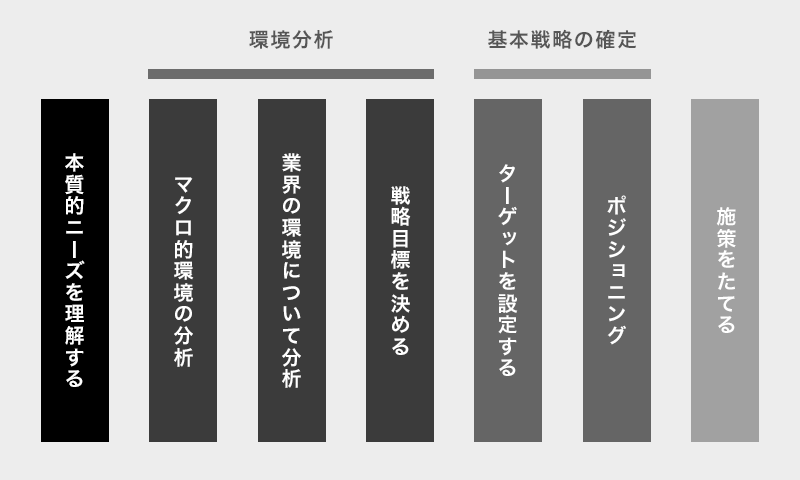
First, it's about grasping essential needs. To sell any product or service, you must understand needs. Even a single need can be quite profound. For example, you probably think of desires like 'I want this, I want that' every day.
The product provider wants to know what you want. Naturally, if they don't sell the desired product after knowing what you want, it won't sell. However, let's say they conduct a survey and ask you 'what you want.' Even if they sell products based on those results, they sometimes don't sell. Or rather, isn't it more often that they don't sell?
The seller thinks, 'I carefully listened to the customer's wishes and sold a product that matched those wishes, so why isn't it selling?' The answer is that responses gathered from simple survey results are not true needs.
It is said that only about 5 percent of a person's true needs can be expressed through words or text. If you conduct a survey, you must design questions that elicit essential needs. For example, let's say there's someone who wants to replace their computer. Naturally, you'd think of selling a computer to this person, but there's something you need to consider first.
That is, 'Does this person really want a computer?'
First, you must analyze why they want to buy a computer, the reason for their desire. Let's call the person who wants a computer 'Mr./Ms. A.' Mr./Ms. A primarily used their computer daily for watching videos, mainly movies. However, their computer became old and broke, so they are considering buying a new one to watch videos.
In the above case, other methods for watching videos can be considered. For example, a tablet. You can watch videos on tablet products like the iPad. Plus, they are portable and convenient. Also, if you can utilize a TV, there are products like Apple TV that connect internet services to your TV. With Apple TV, you can enjoy movies you used to watch on your computer on a large TV screen. Moreover, you can enjoy various streaming services like Netflix and Hulu on your TV.
If enjoying movies and videos was the primary use case, you wouldn't need to buy an expensive computer; instead, you could purchase more video-specialized products like an iPad or Apple TV. In this way, "how to solve the user's core problem" can be said to be a genuine need. Only by uncovering this need will products be loved and sell well.
Macro Environmental Analysis: PEST Analysis
Once you've uncovered the needs, it's time for analysis. The analysis method I'm about to explain is called a "thinking framework," which is a thought tool for formulating strategies by gathering and analyzing information according to a certain way of thinking.
First, let's look at the broader phenomena. The method for analyzing the environment surrounding products and markets is called PEST analysis. It is also referred to as "environmental analysis." PEST analysis is an acronym for Political, Economic, Social, and Technological, and it involves analyzing the product you are currently trying to create or your own company from these four perspectives.
Political
First, political factors. How will politics change in the future? What will happen to taxes? Will changes in laws affect the business we are trying to provide? Will the existence of the business itself be threatened by diplomatic relations?
Rather, are there any signs from future political factors that could boost the business? For example, if a country adopts policies that encourage overseas business when you are trying to conduct international business, it will support your venture. Consider possible changes at the national level and gather information.
Economic
Next, economic factors. Fluctuations in markets and prices. From factors like a weak yen, strong yen, GDP growth rate, and the state of the economy, let's identify factors that could lead to business success or hinder it. For example, if the yen weakens, Japanese products will sell better, making export-related businesses profitable. Conversely, foreign products will become more expensive, increasing costs for imports and overseas real estate, which could worsen the situation for those whose businesses are centered on foreign products.
Social
What is social? How are societal ways of thinking changing? Does it align with current trends? Let's track changes hidden in people's daily lives, such as population fluctuations, lifestyle changes, shifts in people's mindsets, historical backgrounds, and culture. For example, if the social trend indicates an increase in remote workers in the future, proposing services tailored to remote work could be one possibility.
Technological
And then, technological factors. Various technologies are continuously evolving. As AI continues to spread, many people likely understand this deeply by now, but just as technological advancements will eliminate jobs in 10 years, they will also bring significant changes to future businesses.
Perhaps even a previously thriving business could vanish in an instant due to technological innovation by a giant corporation. What technologies will emerge in the future, and which fields should we challenge? Can our business continue even if technological innovation occurs? It is necessary to gather information.
By conducting a PEST analysis, you can gain assurance that the business you are launching can survive. Environmental factors, in particular, have a significant impact, capable of collapsing a business in just a week, or even a single day. It is necessary to thoroughly investigate and analyze. Perhaps by taking measures at this stage, you might find a way to avert future crises.
Analyzing the Industry Environment: 3C Analysis
Once the environmental analysis is complete, let's move on to "industry" analysis. We'll narrow the scope slightly from the concept of environment. The 3C analysis is used when conducting industry-specific analysis. 3C stands for "Customer," "Competitor," and "Company." By gathering and analyzing industry information and changes from these three factors, you can foresee the future of your products.
Customer
First, let's start with the market. What is the market? First, market size. We investigate how much money is circulating within the market. However, if the market is currently immature or not even created yet, let's research similar markets. This is especially relevant when receiving investments or loans, but market size is definitely something to include in your business plan.
Also, how many potential customers are there? If you start this business, how many people are likely to become your customers? The future of the market. When considering the future, how much potential does that market have, and what are its growth prospects? Also, where exactly are the potential customers? How do they purchase, or not purchase? Let's thoroughly investigate everything related to the entire market. By the time you finish, you should have a clear picture of the reality of the market you are currently targeting.
Competitors (competitor)
Once the overall picture of the market becomes clear, let's now look at competitors. Key points for gathering information about competitors include: how many competitors there are, which companies are most likely to be competitors, what kind of strategies competitors employ, what is the scale of competitors, what are competitors' strengths and weaknesses, how much market share do they hold, and how much profit do they make? Gather as much information as you can about competitors.
As a result of these investigations, what gradually becomes clear are the opportunities to exploit against competitors and where we should attack from. This information, such as how our company should act and what measures we should take against competitors, will also be important in the later strategy-setting phase. Furthermore, industry customs will also become apparent. What are the basic prices? What kind of strategies are typically adopted? There are many points to look at, but let's deepen our understanding of the market by examining the state of competitors.
Our Company (company)
Once you have a clear picture of your competitors, let's now look at your own company. If you have already started a business and have established a certain presence in the market, then, just like with competitors, re-evaluate your current situation, including sales, strategies, current costs, and market share. Organizing your company's current state and considering your own situation is an important step.
If you are about to start a business, re-evaluate the sales, strategies, and market share you expect to achieve in the future. It's also a good idea to reconsider the direction of your business. This is because, having researched competitors, the market, and environmental factors so far, you should have discovered points that need to be re-examined and revised. Taking these changes into account, try writing down your company's information once.
Determining Strategic Goals: SWOT Analysis
So far, we have identified needs, viewed the business macroscopically, and researched the industry. Our understanding of people's needs, the industry, and the market should have deepened considerably.
While the previous research was primarily for gathering information to formulate a strategy, your understanding of the business you are about to undertake should also have deepened. Only after this much research can the foundation for determining your company's strategic goals finally be laid. Conversely, if you don't thoroughly gather and analyze information, you will likely end up acting haphazardly.
From here, we will determine strategic goals. A commonly used approach for determining strategic goals is SWOT analysis. SWOT is an acronym for Strengths, Weaknesses, Opportunities, and Threats, and it is a way of analyzing your company's current situation from each of these perspectives.
First, let's look at strengths. What are strengths? As the word suggests, write down what your company perceives as its strengths. Conversely, if there are strengths, there are naturally also weaknesses. Please write down the areas you currently perceive as weaknesses.
And then, Opportunities. What does this mean? It refers to the chances for your business to enter the market, which you would have found during your research so far. What kind of opportunities and chances exist in the market you are trying to enter?
Finally, Threats. Let's list competitors and rivals who already hold a large market share in the industry you are trying to enter.
In reality, you should be able to create this much by extracting some information from what you've researched so far. The analysis points start from here. When conducting a SWOT analysis, consider the following four points:
- Can we leverage our Strengths to seize Opportunities?
- Can we overcome our Weaknesses to avoid Threats?
- Can we leverage our Strengths to counter Threats?
- Can we overcome our Weaknesses to seize Opportunities?
Analyze your company's environment from these four combinations. For example, let's say there's a website production company. Assume its strengths are 'affordability and speed.' Its weakness is 'average quality.'
And as an opportunity, 'the era has come where all companies feel the necessity to create a website.' As a threat, 'there are many production companies that offer affordability and speed.'
However, let's assume that the threat also shares the same weakness: if you prioritize affordability and speed, the quality inevitably decreases.
First, regarding point 1: Can we seize the opportunity that 'the era has come where all companies feel the necessity to create a website' with affordability and speed? This is possible. In today's world, where speed is demanded, if you have speed and affordability, there will undoubtedly be people who seek it.
What about point 2? The weakness of 'average quality.' This simply means making an effort to improve quality. However, since affordability and speed need to be maintained, the production team must be able to efficiently deliver high-quality deliverables.
How about point 3? Can we counter 'there are many production companies that offer affordability and speed' with 'affordability and speed'? This can be countered by not only pursuing affordability and speed but also by making efforts to improve responsiveness, the service itself, and quality. If strengths directly clash, it's best to leverage your original strengths while also considering how to provide other desired aspects with high quality.
Regarding point 4: Can we overcome the weakness of 'average quality' and seize the opportunity that 'the era has come where all companies feel the necessity to create a website'? Overcoming this weakness can also lead to differentiating yourself from other companies. If the quality is higher than others, and it's also fast and affordable, customers will naturally flock to you. It's possible.
In other words, the direction for this time is to first consider what measures should be taken to improve quality while maintaining speed and affordability. There are other things to consider, such as sales capabilities and public relations, but before that, it will likely be necessary to enhance the appeal of the product itself.
If you are moderately successful in getting work with your current sales capabilities, it's easy. Even without improving sales capabilities, if you can improve quality while remaining affordable and fast, you can acquire even more customers. Thinking about how to clear the current situation with minimal effort leads to differentiation.
Set the target: Segmentation
The vector for the strategy has also become clear. From here, we finally enter the phase where the basic strategy is determined. The content covered so far can be said to have deepened our understanding of the industry, appropriately recognized our company and the market, and provided the groundwork for actually stepping into business. The next thing to consider is how to spread our business and get more people to use it.
First, let's set the target based on the information gathered so far. No matter how good your product or service is, trying to sell it to people who don't want it will not work. You need to thoroughly consider where the people who want it are and what they are doing. This is where segmentation becomes necessary.
The market has many customers with various needs. Indiscriminately sending out information, such as advertising and promoting to all customers, will naturally lead to inefficient investment. If you're going to spend the same amount on advertising, it's more effective to carefully consider where the customers who want your product are before placing ads. First, let's gather information about customers who like your company's products.
There are various angles such as age, gender, family structure, income, occupation, position, where they live, lifestyle, personality, values, and purchasing motives. These are sometimes called demographic variables or psychographic variables. We collect these demographic and psychographic data and divide them into various groups.
For example, you can divide them into various segments, such as high-income individuals who are busy with work, or low-income individuals who make a living through part-time jobs. Among these, we will focus our information dissemination on the segment most likely to be interested in our products and business. This will increase the cost-effectiveness of the investment.
Furthermore, we delve deeper into the customer image, known as a persona. For example, what time does the prospective customer wake up, and in what mood do they eat breakfast? With what energy do they leave home for work, and with whom do they have lunch? How do they feel about their work after lunch break, and what time do they return home?
How do they feel about their work and daily life? With whom do they eat dinner and what do they talk about, what time do they take a bath and go to bed? What do they think about and how do they feel when they get into bed? We thoroughly think through every detail so that their persona is understood from corner to corner.
Then, consider which segment the thoroughly thought-out persona belongs to. By further subdividing the group and disseminating information based on that, you will be able to formulate a more effective marketing strategy.
Clarify differentiation through positioning
Now, we have pinpointed where the customers are. Next, let's give a clear differentiation to our own position. We will use a method called positioning. Many people have probably seen or heard of this method.
When you look at presentation materials, you often see a diagram with crossed lines, each axis given a meaning, and several circles scattered on the graph. This is called a positioning map. Positioning is the process of using such a map as a tool to confirm the position of competitors and your own company on two specific vertical and horizontal axes.
First, how are the two axes determined? They are given elements that serve as triggers for purchase when choosing a product. Usually, these axes should be apparent during 3C analysis or SWOT analysis.
For example, in the case of the website production company mentioned earlier, first, is the price low or high? Let's make this the vertical axis. And the horizontal axis is quality. We'll use whether the quality is high or low as the horizontal axis. Most customers compare quality and price, so we'll use price and quality as the two axes for the factors.
By the way, there are no absolute rules for what to use as the criteria for the horizontal and vertical axes, but choosing appropriate two axes will clearly show your position within the industry.
The purchasing decision factors that determine these vertical and horizontal axes are sometimes called KBFs. While considering KBFs, let's identify potential competitor companies and determine where each competitor is positioned. Areas where many competitors are concentrated will have high competition, so your company should aim to brand itself by taking a position in an area where competitors are not densely clustered.
Simply put, competitor companies are likely to cluster in either high-priced, high-quality or low-priced, low-quality segments. If so, positioning yourself to offer a certain level of quality even at a low price would mean less competition and easier acquisition of work.
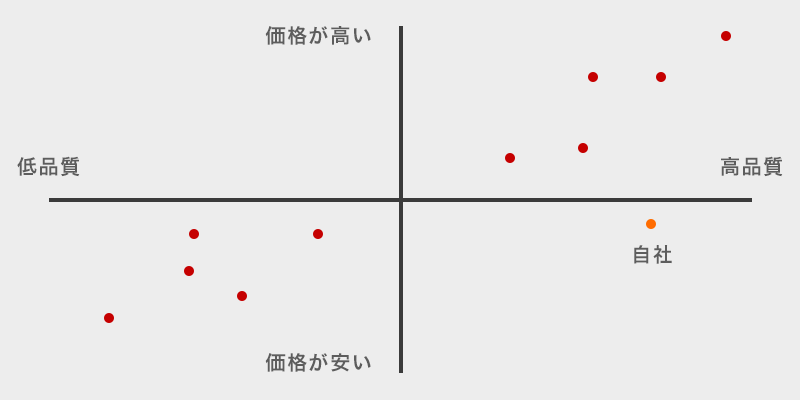
In this way, after thoroughly understanding your own position, you need to use a positioning map to clearly grasp your company's standing in order to formulate future strategies. Creating this document will also make it easier to communicate your company's position to your colleagues.
In addition to the positioning map, let's extract several other KBF items and compare them with competitors. By making it clear at a glance which decision factors your company excels in and which items allow you to differentiate from others, it will be easier to formulate concrete strategies later on.
Now, through this process, the foundation for thinking about concrete measures has been laid. You have gathered information, grasped future environmental changes, deepened your understanding of the market, identified your own strengths and weaknesses, those of your competitors, and determined what direction you should take. You have also clarified your company's position within the industry, who your customers are, and where they are located. I believe a great deal of information has been collected.
With this, you can finally enter the phase of deciding specifically what to do. If the research and discussions up to this point have been insufficient, you risk making the mistake of fundamentally heading in the wrong direction, so let's proceed after deepening your understanding.
Deciding on Concrete Measures: 4P
Finally, we will start creating concrete measures. The framework used here is called 4P. 4P stands for Product, Price, Place, and Promotion, and it is a method of building a sales strategy by considering these four keywords, which are the main pillars of business.
Product
First, the product. For the product, you will decide all its elements, such as the lineup, color variations, quality, brand name, and design. Look back at the information you have gathered so far. What colors resonate with the target audience? What is the brand name? How will the design be? And, have you reflected points that can differentiate you from competitors? By incorporating what you have considered so far, you should be able to create a product that stands apart from those previously existing in the market.
Furthermore, differentiation today means "something with a clear difference from the consumer's perspective." In the TV and home appliance industries, there are many products with functional differentiations that general consumers don't understand, or that salesclerks might say are "mostly the same." Such minor differentiations are meaningless. What is needed are differences that are clearly visible and audible.
A long time ago, there weren't many convenient products themselves. So, if you sold something new, it would sell like hotcakes. But in today's world, overflowing with convenient things, that's no longer the case. Differentiations that come to mind quickly or the addition of minor features are tiresome. They don't create much impact. It's good to keep in mind that something overwhelmingly different in terms of differentiation will be necessary.
Nevertheless, in some industries and for some products, simply differentiating through sales power or other optional services might still lead to increased sales.
Price
Once the product is decided, the next is price. Price is one of the biggest purchasing decision factors for customers. No matter how good the features are, if the price far exceeds the customer's imagination or is set inappropriately for the current price range, it will not be picked up.
There should not be a significant discrepancy between the price range customers perceive and the product's features. If the price can still be raised, it will be necessary to strengthen the brand as a high-end product. It is also necessary to consider whether such a brand fits modern social conditions and is in demand. Let's ensure there is no discrepancy between the perceived price and the actual price.
In addition to setting these standard prices, discounts and payment deadlines also become factors to consider. Even if it's a bit expensive, allowing payment in installments or incorporating the cost of the main unit into a monthly usage fee, like with mobile phone carriers, might enable the sale of high-priced items without customers being overly conscious of the cost. Let's decide every detail regarding prices and costs.
Distribution (Place)
Once a conclusion is reached on pricing, the next thing to consider is distribution. Which channels will deliver the product to the customer's hands, and what is the delivery time? In recent years, distribution has made significant progress, especially in speed. Services like same-day delivery are even being realized, primarily by amazon. In the future, distribution may require particular attention.
Furthermore, for digital downloads, there is distribution that is completed entirely online. As product sales to overseas markets are expected to accelerate, it will become necessary to consider areas outside Japan. In addition to basic logistics systems, this includes production, inventory status management, and, for physical stores, location conditions. Let's thoroughly think through the process of delivering products to customers.
Recent advancements in distribution have been rapid, and it has become normal for orders placed online from home to arrive immediately. This means that, when sending products, the longer it takes, the more burdensome ordering might feel to customers. Soon, same-day delivery might be possible for any product!
Furthermore, amazon is considering drone delivery, and Uber is starting delivery services, indicating that the very nature of distribution is beginning to transform, centered on mechanization. It is inevitable that distribution innovations will continue to occur, so it should be monitored in that sense.
Promotion
The last of the 4Ps is Promotion. Any business is meaningless without a path for customers to reach the product. No matter how good a product you create or how cheaply you sell it, if you don't make an effort to let people know about it, it won't lead to sales.
Promotion, which is obvious but surprisingly often forgotten. Or rather than forgotten, perhaps it's more accurate to say, 'I don't know what to do.' As evidence, many small and medium-sized enterprises lack a public relations position. While it's a position that is all the more necessary for SMEs, it is not often deployed.
In promotion, we thoroughly consider initiatives to expand the product, such as how to advertise and publicize, and what the sales power is like. Recently, fields such as SNS, web marketing, and content marketing have become the mainstays of corporate marketing. On the other hand, companies relying primarily on paid advertising are steadily decreasing.
Spreading information itself has also become easier. However, there are also many disadvantages, such as bad rumors spreading easily, so for promotion, it is especially necessary to become knowledgeable about internet PR. Various promotion methods will likely emerge with future technological innovations, and keeping up with the latest information is essential.
Incorporating the latest technology and era into a 50-year-old theory
Once you have researched and decided, all that's left is to steadily execute. Accurately implement what you've decided and expand your market share. However, the basic frameworks and theories we've discussed today are methods that were developed as far back as 50 years ago.
Considering that these theories are still used today, they are certainly excellent ways of thinking and frameworks. However, naturally, the nature of marketing has also changed due to technological innovation. The world where simply using a framework would increase sales is long gone.
Therefore, these are merely 'creating a standard for yourself to think through trial and error.' By deepening your understanding of the business environment, learning about the industry, researching competitors, and gathering a wealth of information, you will inevitably accumulate enough knowledge to make judgments.
By adding a marketing mix that combines multiple frameworks and methods, you will be able to create a basic structure. The problem starts there. You must rethink the accumulated knowledge, information, and vectors in your own mind and devise ways to reach people today.
For example, advertising. A while ago, simply running banner ads would attract people. The effect relative to the cost was somewhat easy to see. For example, 'If you advertise on this medium, you'll sell this much.' Even if the basic theories haven't changed, people's frequency of clicking banners has decreased, and they've become more suspicious. Moreover, people's progress isn't over long spans like 10 or 20 years; their preferences change within a few years.
To capture such changes in people and translate them into data, various technological innovations are occurring in marketing methods. Google Analytics is a given, as are heatmap analysis tools. Back-office operations like sales and taxation are also greatly streamlined by tools, and distribution systems have also changed significantly.
Today's society is one where both technology and people are continuously acquiring new values and perceptions at an unprecedented speed. Therefore, simply applying a framework is insufficient. It is only by repeatedly performing 'verification' and 'improvement' beyond that, that a measure becomes effective.
It is important to constantly check industry trends and also pay attention to the latest marketing tools and methods. Furthermore, what is most important is not to forget to solve fundamental problems with 'your own mind'.
You must thoroughly deliberate on how to increase sales yourself, how to expand awareness most effectively, and then invest your best ideas. Frameworks and ways of thinking are merely preliminary steps before thinking with your own mind. Build a solid foundation for thinking in the preliminary stage, try it out, and through repeated verification and improvement, transform it into a more effective form. The ability to solve problems yourself is the power that maximizes marketing effectiveness.
From now on, both marketing and the world will continue to evolve rapidly. In this environment, even if all previous know-how suddenly becomes obsolete one day, let's learn to apply our experience and accumulated knowledge to survive in any era.
WRITTEN BY
上山 翔太
2007年からWEBデザイナー / エンジニアとして活動を開始。2015年には、セブ島にて立ち上げた日本人対象のクリエイター育成スクールと運営していたメディアを売却。その後、アメリカで事業デザインを無理やり学ぶ。帰国後は起業家育成プログラムを立ち上げ、新規事業開発、起業家育成に従事するほか、マーケティング戦略策定、ウェブ開発技術を提供。「IT留学シェアハウス」や「起業教育・支援プラットフォーム」を開発、運営。その後、株式会社QUONを立ち上げ。WEB制作事業を軸として、クリエイターと起業家を産む村づくりプロジェクトなどをバリ島と日本を中心に推進。


